





What can a well-organised ‘anilox corner’ do for a printing company?
The text, statistics and equipment specifications are presented as they stood at the time of publication.
Hello.
LaserEcoClean here. We have been laser-cleaning anilox rolls for flexographic printing companies for fifteen years. Our mobile systems operate in the EU, Mexico and Australia, while our stationary machines have been installed in more than ten countries.
The company Zecher GmbH uses our equipment in its anilox roll manufacturing process.
We offer the world’s fastest anilox roll laser cleaning: a 1,360 mm roll is cleaned in ten minutes.
We developed LaserEcoClean, the safest technology on the market: in our machine, the same clean roll can be cleaned continuously for 24 hours at the standard settings without damaging the ceramic.
In 2010, we were a start-up offering mobile anilox cleaning. Today, we are an engineering company and a service provider for everything connected with anilox rolls.
Our company has an evolutionary goal: factories that are safe for people and the planet and that deliver the greatest possible profit to their owners by reducing production costs through the maximum automation of every process.
That is what we see as the outcome of our work. That is how we can be useful to our customers.
What is this article about?
The goal is global, but in this article I would like to focus on what one small yet important part of every flexographic printing company should look like. Let us call it the ‘anilox corner’.
What should the ideal ‘anilox corner’ look like? What benefits can a printing company gain by bringing order to its anilox roll fleet?
For many years, we have received feedback from customers in the Americas, Europe and Asia. Today, we would like to share the vision that has taken shape over those years.
Order in the ‘anilox corner’: the ultimate goal, the benefit to the printing company and the possible solutions.
We have identified four principal tasks that must be addressed in order to use your employees’ time as efficiently as possible, reduce press downtime caused by anilox-related problems and, ultimately, lower the cost of the products you manufacture.
Task 1. Cataloguing. Bringing order to the roll storage area;
Task 2. Speed. Safe cleaning after every print run;
Task 3. Diagnostics. Information on roll condition that is always up to date;
Task 4. Service. Timely replacement of rolls.
Task 1. Cataloguing. Bringing order to the roll storage area.
The ultimate goal: a database containing current, well-organised information on every roll, while taking as little staff time as possible to maintain.
The benefit to the printing company: less time spent by process engineers, printers and anilox-cleaning operators entering and searching for up-to-date information about the rolls.
Cataloguing. How do we see it?
Every roll in a printing company should have its own place. Each place should be marked with a label carrying current information about the roll. Ideally, the rolls should be divided into groups — by line screen, for example — and each group assigned its own colour. All roll information should be entered in a database and updated at defined intervals: the roll’s ink-transfer value might be updated monthly, for example, while new scratches and chips should be recorded weekly. Once a month, the key data should be printed on coloured magnetic labels that remain with the roll as it moves through the plant. All this should take the printing company’s employee as little time as possible.
What information should the database store for each roll?
A short alphanumeric identifier, the manufacturer’s serial number, line screen, specified ink-transfer value, current ink-transfer value, information on the condition of the roll surface — every chip and scratch, together with its position on the roll — the date of the most recent cleaning, date of purchase, wear history and operating mileage. Ideally, the record should also contain photographs of damage; micrographs from which the roll’s wear can be assessed; accurately measured cell-opening diameter, cell depth and cell-wall thickness; and, ultimately, a 3D model of the cells. The labels can display any information you consider important for your work.
What can our company offer to collect and store these data automatically?
We have developed a database capable of storing all the roll information described above. A printer can be connected to it to produce magnetic labels in a predefined format. We manufacture roll-cleaning systems and manual roll-diagnostic systems, and we are also developing a laser roll-scanning system. In other words, our equipment collects all roll data automatically, and we present the customer with the complete information in tables and charts in a cloud database.
Many companies are currently introducing their own ERP systems. If required, we can transfer all the information collected into the customer’s ERP system.
Our specialists need one twelve-hour shift to catalogue 50 anilox rolls from scratch. That includes collecting all the data on the rolls and entering them in the database.
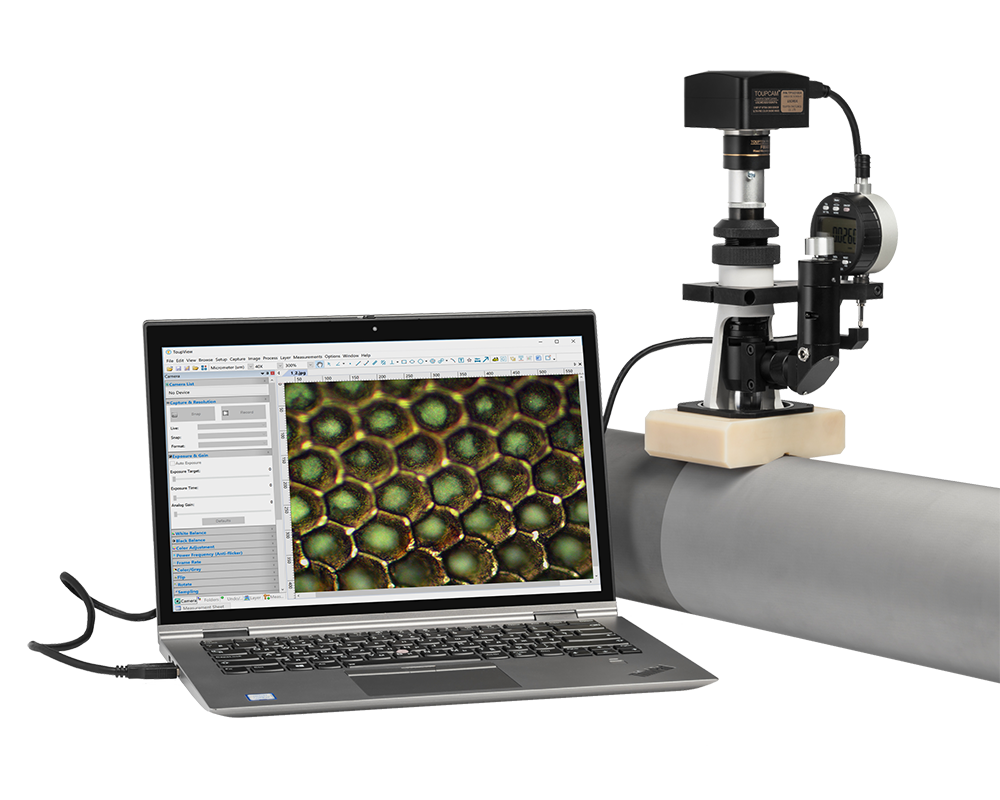
We assume that completing the same task manually could take your employees considerably longer. We also recognise that relatively few people have the expertise required to diagnose rolls properly. We have been diagnosing anilox rolls for fifteen years and have automated much of this work. No matter how many rolls your printing company has, you can use our anilox diagnostic service, or we can give you access to our database so that you can work with it independently. You can also purchase our roll-diagnostic tool — our LEC Micro microscope.
of anilox rolls
Task 2. Speed. Safe cleaning after every print run.
The ultimate goal: install only completely clean rolls with a known ink-transfer value in the press, while spending the minimum possible time on roll cleaning.
The benefit to the printing company: less press downtime caused by the condition of the anilox rolls.
Printing companies sell press time. The average market rate for wide-web printing is €400–500 per hour. Press downtime caused by any anilox-related problem is unacceptable. Every roll in the storage area should therefore be clean at all times.
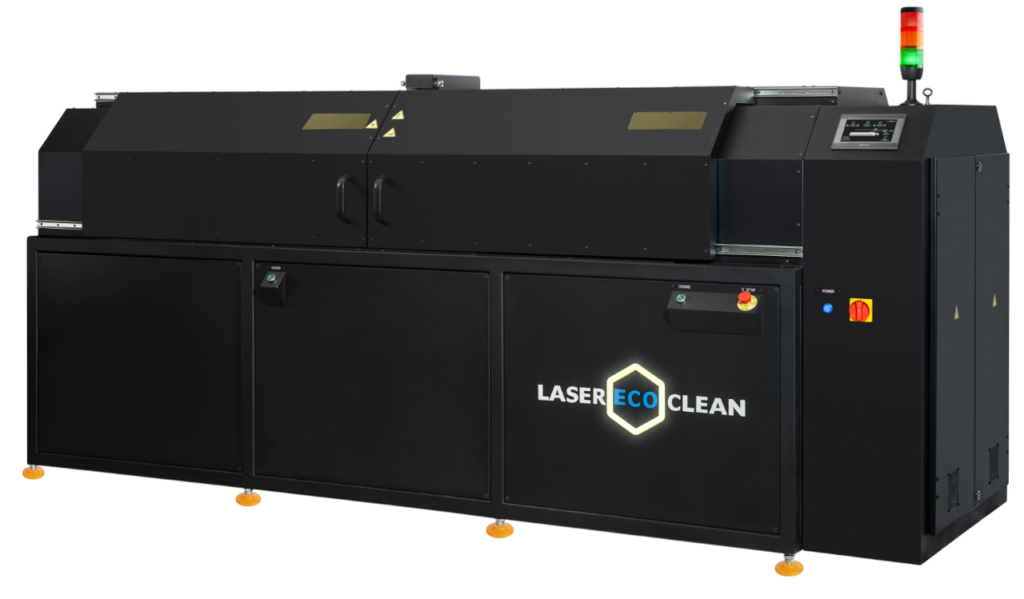
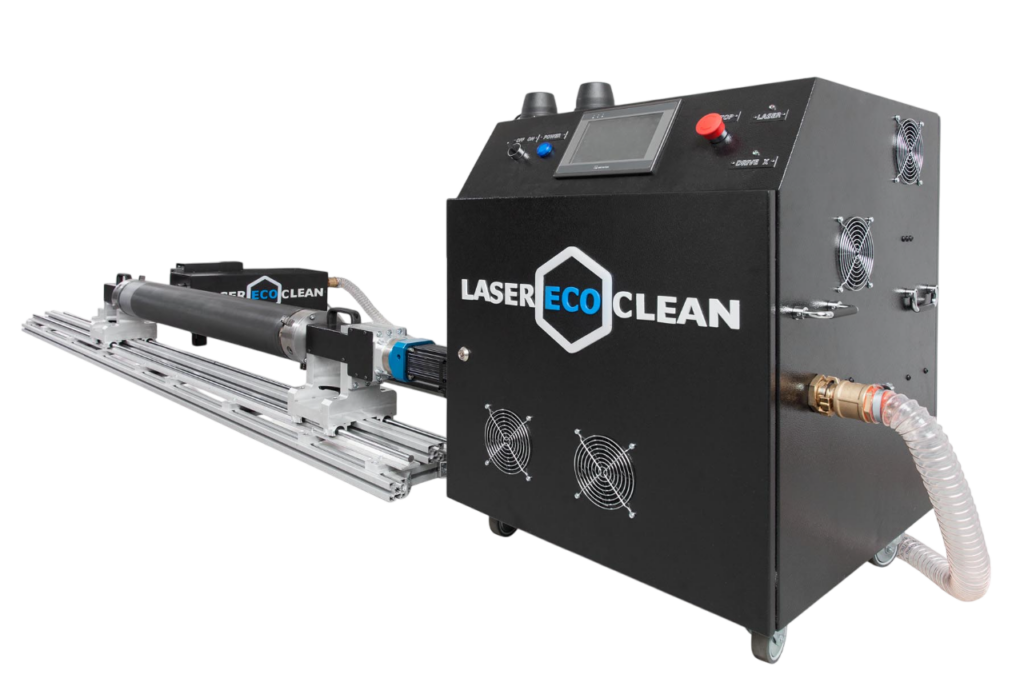
What does this require? The ability to restore a roll’s ink transfer to its specified value in the shortest possible time. The best solution is to clean rolls with a laser focused to a spot as small as 100 μm. This technology requires an extremely precise rotation system and carriage positioning, but it also delivers high speed and safety. We patented the technology and named it LaserEcoClean, or LEC.
| Maximum roll weight: | up to 50 kg | up to 200 kg | up to 500 kg |
| Maximum roll length: | up to 1,800 mm | up to 2,700 mm | up to 2,900 mm |
| Cleaning time per linear metre: |
7–14–28 min depending on the model |
15 min | 15 min |
| Roll diameter: | 60–270 mm | 100–270 mm | 100–370 mm |
| Power consumption: | 2 kW / 5 kW | 2 kW / 5 kW | 2 kW / 5 kW |
| Machine dimensions, L × W × H: | 3,416 × 1,212 × 1,668 mm | 4,757 × 1,212 × 1,668 mm | 5,418 × 1,250 × 1,577 mm |
| Machine weight: | 1,000 kg | 1,700 kg | 3,000 kg |
LEC means speed.
One linear metre of roll is cleaned in either seven or fifteen minutes, depending on the machine model. At these speeds, one of our customers cleans as many as 950 rolls a month from a fleet of approximately 250. Cleaning the entire fleet four times a month is what we recommend to everyone who uses our equipment. At that frequency, ink simply has no time to accumulate in the cells, and you can always be confident that the roll’s ink transfer will meet your expectations at any given moment.
LEC means safety.
Our contract states that daily anilox cleaning with our technology produces no change in the anilox ceramic surface.
Recently, two large printing companies conducted a series of tests in which the same clean roll was cleaned continuously in our machine for 24 hours. The purpose was to prove the safety of LaserEcoClean technology. We are proud that the equipment passed those tests.
LEC saves you money.
Our equipment consumes approximately 2 kW, and the laser has a service life of around fifteen years in single-shift operation. A replacement filter costs €35 and is changed once every 400 operating hours.
Anilox cleaning must be safe not only for the roll, but for people as well — not to mention the environment. If you have ever stood in an anilox corner beside an ultrasonic or chemical cleaning machine, I doubt you were seized by the desire to spend five days a week working there. Vapours, noise and constant contact with chemicals do no one any good. Laser cleaning is quiet, while all odours and soot produced by the burnt contamination are filtered inside the machine.
Task 3. Diagnostics. Information on roll condition that is always up to date.
The ultimate goal: the systematic collection of current data on the condition of every roll, with the minimum possible demand on the printing company’s staff time.
The benefit to the printing company: less time spent by the process engineer and anilox-cleaning operator determining the condition of a roll.
A roll’s condition means its current line screen and ink-transfer value, together with every form of mechanical damage.
Anilox diagnostics is not a trivial task. Measuring ink transfer is a complex process, and we have yet to see a simple solution on the market. The measurements demand considerable time and expertise from the operator. In our view, all the available methods have relatively high measurement uncertainty and are fairly expensive.
Current ink-transfer data, however, allow a printing company to reduce make-ready time — and therefore equipment downtime — and to plan ink consumption. Information about roll damage can extend roll life, because a roll with known defects may still be used for certain designs. Historical data showing the decline in ink transfer reveal the rate of roll wear and can help identify its cause.
Our database maintains a list of audits for each roll. With our LEC Micro microscope, you can measure line screen and ink transfer with minimal measurement uncertainty and analyse the surface condition. For the moment, however, chips and scratches that appear on the roll must still be entered manually.
We are currently developing a laser surface scanner that will create a 3D map of an anilox roll, automatically measure its line screen and ink transfer, and ‘see’ every defect on the roll.
Task 4. Service. Timely replacement of rolls.
The ultimate goal: use systematic roll audits to identify heavily worn rolls automatically.
The benefit to the printing company: use historical data to prepare proactively for roll replacement and reduce the time spent printing with rolls whose ink transfer has declined.
Based on the diagnostic data, our database creates a table of rolls that have lost 15%, 30% or 50% of their ink-transfer capacity and recommends them for replacement.
As a rule, a 25% reduction in ink transfer combined with a cell-wall-to-opening ratio of 1:8 or lower indicates that the roll has been worn down. A ratio below 1:3 means that the anilox is already behaving like a ductor roll.
Once you have determined — either with our help or independently — which rolls need replacing, we can supply new anilox rolls from leading manufacturers.
What is our advantage? We understand roll diagnostics extremely well. Our specialists are in regular contact with leading European roll manufacturers and can inspect your rolls at the manufacturer’s plant before accepting them on your behalf: measuring the line screen and ink-transfer value and checking the roll for damage.
We provide data on the mechanical strength of the ceramic.
Our team will give you more assurance and more information about ceramic quality than any other roll supplier.
If you need professional roll diagnostics or have concerns about roll quality, we can inspect the rolls for you and provide complete information about their condition.
We are now working on reliable ways to determine ceramic hardness and answer the most painful question of all: why have radial bands appeared on the roll? Who is to blame — the ink, the doctor blade, the cleaning system or the roll manufacturer, whose ceramic ‘used to last five to seven years, but now fails after three months’?
Conclusion.
So, how can we help you bring order to your ‘anilox corner’?
If you are a medium-sized or large printing company with a fleet of at least 40 rolls, we can offer you a laser cleaning machine, a microscope for roll diagnostics and a database.
If yours is a smaller printing company, we offer a mobile cleaning service and an on-site roll diagnostic service. We can now do more than clean your rolls: we can take a complete inventory, measure every anilox parameter, prepare labels showing the current values, and record every chip and scratch in the database. We will give you access to the cloud database so that, independently or with our help, you can keep your production operation in order. We will identify every roll with significant wear and, if replacements are needed, calculate the delivery cost of new rolls.
We are currently automating the roll-diagnostic process. We want our customers to receive complete information on the condition of a roll surface — its line screen, ink transfer and damage — automatically, by scanning the roll with a laser.
That is all for now. Sixty-five of our machines are hard at work on five of the world’s seven continents without significant failures. We wish the same for you.
P.S. If you have questions or comments about this article or our work, or if you would like to place an order, send me an email.
I will be glad to receive any feedback.
Have a good day.