





Deep laser cleaning technology for anilox rolls
The text, equipment specifications and calculations are reproduced as originally published.
One might suppose that modern printing professionals no longer need an explanation of the role that deep cleaning of anilox rolls plays in the flexographic process, or of its effect on the quality of the finished product. A great many articles have been written on the subject. Yet there is still no consensus as to which technologies can remove dried ink completely and safely from the floors of engraved-roll cells. The reason is that the existing roll-cleaning methods are not universal: their use is restricted by technological considerations, ink type and roll line screen, as well as by economic factors – the high cost of the equipment, for example. Let us examine the modern methods of deep cleaning.
Comparative analysis of modern anilox cleaning methods
Let us begin by defining the principal requirements for a deep-cleaning process for engraved rolls:
- dried residues of ink pigment, resin and other substances deposited on the cell floor must be removed completely;
- the cell structure of the anilox roll must not be damaged during cleaning;
- and the cleaning agents used must be environmentally safe.
Let us consider the most widespread cleaning technology: chemical cleaning. This method either uses specialised equipment or relies on manual labour. In neither case, however, is it possible to control the depth of cleaning: the ink softens and remains quite happily on the floor of the roll cells. No brush can remove it, because the bristles are far larger than the diameter of an anilox cell.
Chemical cleaning also earns a black mark on safety: the chemicals often cause corrosion of the roll’s metal body and, subsequently, delamination of the ceramic coating.
From an environmental perspective, it is the least desirable method; the chemical reagents used for this purpose pose a direct risk to human skin.
From the above, one may conclude that the result of chemical cleaning can be unpredictable and unsafe. Its advantages are the relatively low cost of cleaning pastes and the method’s wide availability, which stems from its technological simplicity.
Ultrasonic cleaning is much safer environmentally than the preceding method, but it too does not always remove dried ink from the cell floor, because the cavitation process — ‘cold boiling’ — on which it is based is difficult to control and, ultimately, does not deliver the required standard of deep cleaning. Ultrasound can also, in some cases, pose a risk to the ceramic coating: interference between sound waves redistributes their intensity and creates local maxima, which may cause localised cracking of the coating. The rolls most at risk are older rolls, as well as rolls with very high or very low line screens.
Ultrasonic cleaning is an order of magnitude better than chemical cleaning, but the low level of process control means that it still falls well short of the required cleaning quality. Consequently, when these deep-cleaning methods are used, average roll life may be considerably shorter than the roll manufacturer predicts. The two methods also share another limitation: the types of ink they can remove. Dried water-based and titanium-dioxide inks are virtually impossible to eliminate.
The most advanced of the conventional methods is media blasting with specialised granulate, or, in some cases, sodium bicarbonate. The process relies on the impact of granules against the dried ink, but here too the cell cannot be cleaned completely because the momentum of each particle remains constant and does not vary with cell depth. Media blasting is not always safe for high-line-screen rolls, since under some conditions it can break thin cell walls. Its effectiveness is also limited at high line screens if the granules are larger than the cells. Cleaning quality depends on granulate quality, making the printing company dependent on its consumables supplier. Media blasting is best suited to anilox rolls with medium and low line screens, although the equipment is affordable only to very large printing companies.
All the methods described above involve relatively modest but recurring expenditure on consumables: chemicals, softening pastes for ultrasonic cleaning, granulate or sodium bicarbonate for media blasting, and so forth.
Unlike the methods considered above, laser cleaning of anilox rolls avoids most of these disadvantages: dried ink is removed completely from the cell floors; the power densities used do not destroy the roll’s thin cell walls; the process requires no consumables and is environmentally safe. Its disadvantages are the difficulty of determining safe roll-cleaning parameters and the technological complexity of the system.
Advantages and disadvantages of anilox roll laser cleaning
First, let us briefly describe the mechanism of laser surface cleaning (Fig. 1).
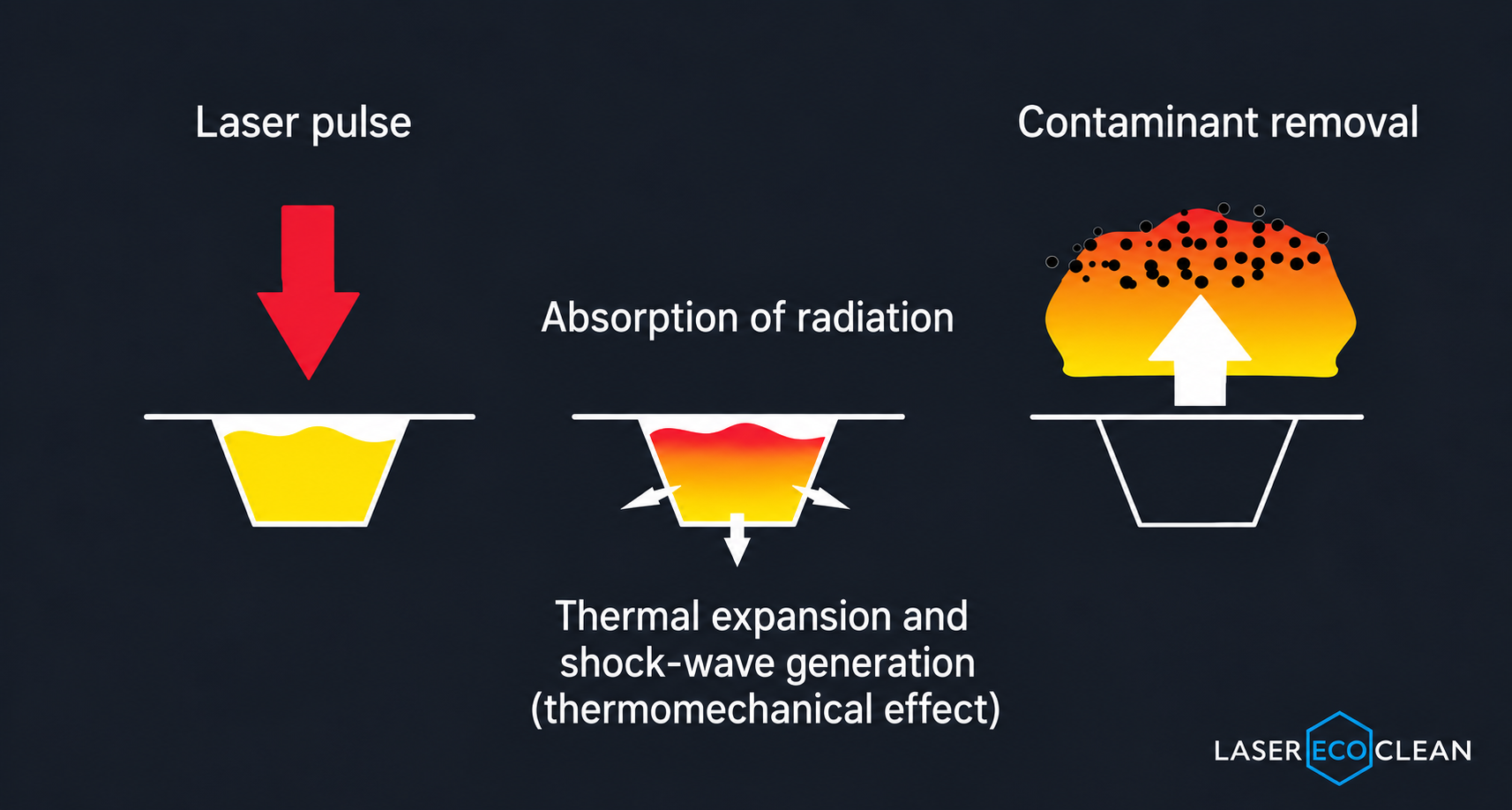
Contamination can be removed in two ways: the first – direct ablation, or vaporisation; the second – thermomechanical, or shock-wave, removal. Low-threshold thermomechanical ink removal is safe for the substrate and takes less time. As the radiation is absorbed, the contamination undergoes rapid thermal expansion and its thermodynamic properties change. A discontinuity surface — a shock wave — is formed, breaking the adhesion between the dried ink and the surface. Once exposure to the laser radiation ends, the elastic properties of the contaminant generate an inertial force [2], which causes the dried ink to detach.
By changing the focal distance, the cleaning depth can be controlled; focusing the laser beam to the required spot diameter also makes it possible to remove ink from several cells at once. Neither the type of ink nor a high line screen is a limitation for the shock-wave mechanism of laser cleaning.
To confirm the safety of the method, experiments were conducted in which anilox rolls coated with white TiO₂ ink were cleaned repeatedly. After every fifth cleaning cycle, the same seven cells were photographed (Fig. 2).
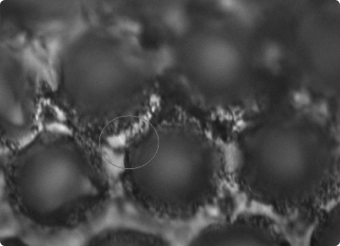
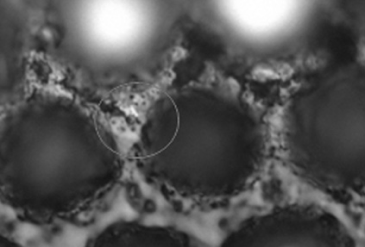
Laser cleaning is therefore a universal method capable of removing all types of polymeric and organic contamination and of cleaning anilox rolls of any line screen without damaging their microtextured surface. The process requires no consumables and is environmentally safe (Fig. 3). A modern fibre laser has a service life of approximately 30,000 hours.
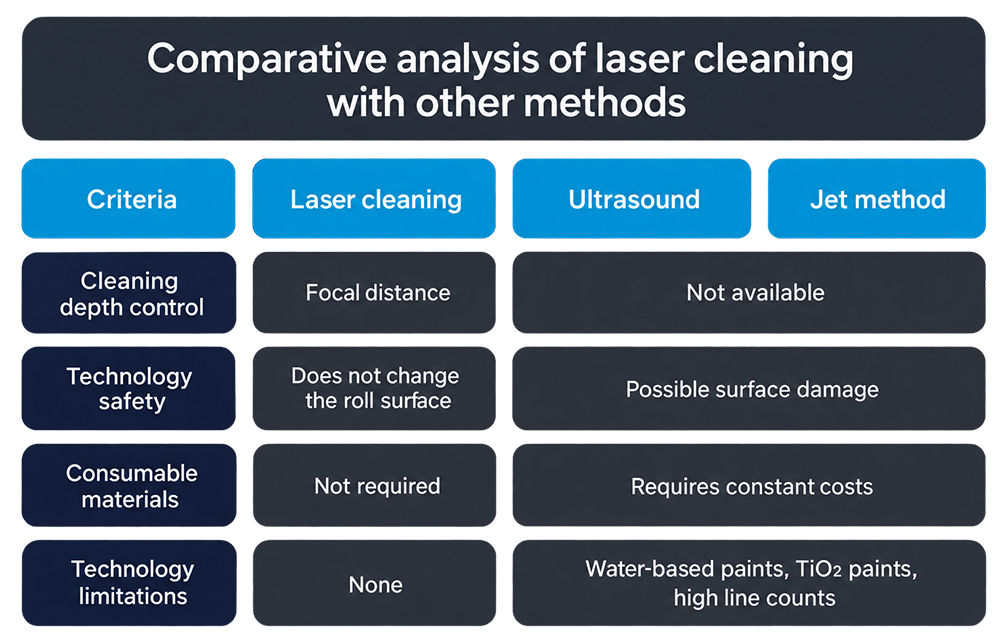
The research produced process parameters for safe, deep laser cleaning of anilox rolls and led to the construction of a prototype machine for providing roll-cleaning services. The maximum overall roll length was 920 mm. A roll with a 300 mm working face took between 30 and 60 minutes to clean, depending on the degree of contamination. An industrial version of the machine was under development at the time.
As for roll diagnostics, cleaning quality is assessed using modern metallographic microscopes with magnifications of up to 1,000×. Cell depth is measured with a profilometer whose stylus has a 5 μm tip radius. This equipment makes it possible to assess roll contamination before cleaning, verify the cleaning result and confirm the safety of the laser process.
Technological aspects of anilox roll laser cleaning
For removing thin layers of contamination, a multipulse laser-cleaning mode is the most efficient in terms of both productivity and energy use [1, 2]. It is therefore appropriate to use a pulsed fibre laser to remove contamination from the microtextured surface of an anilox roll. This laser source offers a wide adjustment range for the pulse repetition frequency (f = 20–100 kHz) and high beam quality, M² = 1.1. A further advantage is that printing inks absorb near-infrared radiation well: at a wavelength of 1.06 μm, the absorption coefficient is approximately 0.8.
The removal of an ink layer is a threshold process. As the exposure temperature rises, the sequence is melting, thermomechanical ink removal and, finally, vaporisation. We consider thermomechanical removal to be the optimum mode for eliminating contamination safely [2].
No mathematical models of thermomechanical removal have yet been developed, but it is possible to make the energy estimates needed to design the process. Removing ink requires its adhesion to the anilox surface to be broken. This is caused by displacement of the contaminant particle as a result of thermal expansion [2]:

where k – a coefficient reflecting the manner in which the contaminant is heated, hp – the particle thickness, corresponding to the cell depth of the engraved roll, ap – the coefficient of linear thermal expansion, and T – the specified temperature.
The coefficient k is equal to 0.5 because the particle is heated uniformly through its thickness [4]. The thermophysical properties of the ink may be approximated by the physicochemical constants of rosin, since what dries on the floors of engraved-roll cells is the binder and pigment of the printing ink. The binder is a modified organic resin; therefore:
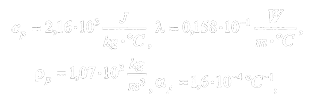
where  – the specific heat capacity, thermal conductivity, density and coefficient of linear thermal expansion of rosin, respectively [3].
The boiling point of printing ink is approximately 250°C [3], while it is known that, owing to the thermomechanical effect, the contaminant detaches in the solid phase [2]. The specified temperature T may therefore be taken as no more than 250°C. It should be noted that temperatures during laser engraving of rolls reach 2,500°C.
On substituting T, equation (1) gives the particle displacement: dp = 0.2 μm; the integration limits are 0 to 10 μm, corresponding to the thickness of the ink layer being removed.
Using the specified temperature of 250°C, the maximum power density qₘₐₓ can be estimated. For this purpose, we use the solution of the one-dimensional heat-conduction equation expressed in terms of the power density qₘₐₓ [4]:

where T0 – the initial temperature.
The one-dimensional heat-flow condition for laser cleaning anilox rolls is readily satisfied for a spot radius of 50 μm and a pulse duration of τ = 100 ns:
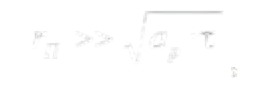
where rₛ – the laser-spot radius, μm; ap – the thermal diffusivity, m²/s; τ – the pulse duration, ns.
Substituting all coefficients into equation (2) gives: qₘₐₓ = 1.49 × 10⁸ W/m².
This power density is readily achieved by modern industrial lasers.
Experimental studies
For the roll studies, a prototype anilox laser cleaning machine was designed and built (Fig. 4). Laser head 2, comprising a collimator and focusing lens 7, was mounted on coordinate table 1, controlled by personal computer 8. This arrangement made it possible to adjust the scanning speed and pitch along engraved roll 5 and to set the focal distance with micrometre-level precision.
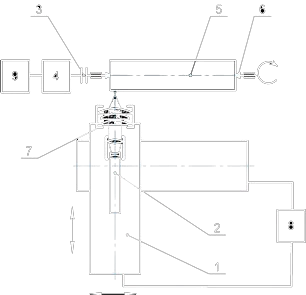
1 – positioning stage; 2 – laser head; 3 – coupling; 4 – electric motor; 5 – anilox roll; 6 – centring cones; 7 – focusing lens; 8 – personal computer; 9 – power supply.
Engraved roll 5 was held in centring cones 6 and driven by DC motor 4 through coupling 3; its rotational speed was controlled by the voltage supplied from reference power source 9. The experiment used a 10 W pulsed fibre laser with fibre delivery of the beam, which is not shown in Fig. 4.
The studies covered several types of ink — UV-curable, water-based and alcohol-based — and rolls with different surface geometries, including different cell widths and shapes. Experiments were performed on both aged deposits more than one month old and fresh ink. The results are presented in Fig. 5, and the experimental parameters are summarised in Table 1.
| Roll | Power density q, W/m² | Pulse repetition frequency f, kHz | Linear roll speed V, m/s | Spot diameter d*, μm |
|---|---|---|---|---|
| 1 | 7 × 10⁸ | 60 | 1.1 | 60 |
| 2 | 7 × 10⁸ | 60 | 0.785 | 60 |
| 3 | 3.5 × 10⁸ | 40 | 1.8 | 120 |
It should be noted that the anilox rolls supplied for the experiments already contained cracks in their microtexture; these were used to confirm the safety of the laser cleaning method. The same area of the roll surface was photographed before and after the experiment (Figs. 5, Ia and Ib). As the micrographs show, the dimensions of the cracks did not change, confirming the safety of the proposed method.
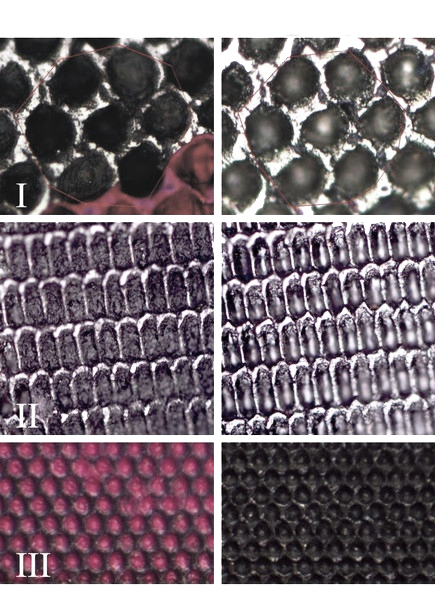
I – roll with a cell width of 30 μm, cleaned of UV ink; II – roll with a cell size of 20 × 50 μm, cleaned of UV ink;
III – roll with a cell width of 120 μm, cleaned of fresh alcohol-based ink.
The maximum throughput achieved with the laboratory installation was one roll with a 500 mm working face per hour. The ink particles were removed in the solid phase, which substantially simplifies the process: an absorbent film can be used instead of an extraction system.
Conclusion
This study experimentally confirmed the effectiveness and safety of laser cleaning for engraved rolls. The process developed meets all contemporary requirements for a cleaning method: it removes ink completely from anilox cells, does not damage the microtextured surface, is environmentally safe and is technologically advanced because it is completed in a single stage.