





07. Different methods of anilox roll laser cleaning
We are aware of three fundamentally different methods of anilox roll laser cleaning:
“Large-spot technology”
This method supports the anilox roll on a set of plastic rollers, which rotate it slowly about its axis. A diode-pumped solid-state laser is mounted perpendicular to the axis of rotation and scans the roll in a helical path using a large spot, up to 1 cm in diameter.
Because this technology uses a large laser spot, it is difficult to clean the anilox uniformly while maintaining a high cleaning speed. If the parameters are not selected correctly, the roll may look patchy after cleaning.
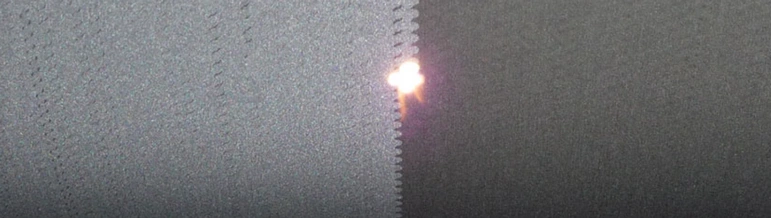
It is also difficult to achieve a uniform energy distribution within a large spot. If the energy profile is uneven, different areas of the surface may be cleaned to different degrees.
Large-spot systems generally use solid-state lasers. These sources have a typical service life of around 15,000 hours. Once they reach the end of their service life, the costly diodes must be replaced. Modern fibre lasers have a service life of approximately 100,000 hours.
“Beam-scanning technology”
This method uses a laser beam scanner. In the scanning systems we have studied, incorrectly selected parameters can alter the geometry of the cell walls. We do not recommend scanning systems in which a single point on the surface receives several overlapping pulses. If the cleaning parameters are selected correctly, one fibre-laser pulse with minimal overlap is sufficient to remove most polymeric and organic contamination from an anilox cell. Under the scanning conditions we studied, each point received between 3 and 15 pulses. Any excess energy remaining after the contamination has been removed is therefore transferred into the anilox roll’s ceramic coating.
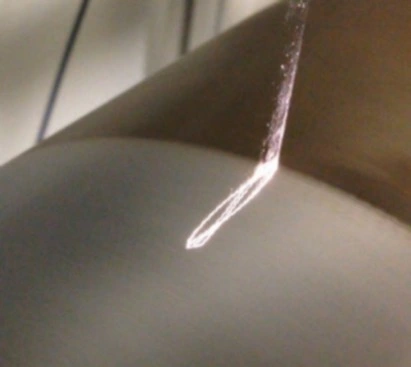
Multiple overlapping pulses strike the same point.
In our view, scanner-based cleaning is well suited to removing contamination from building facades, asphalt and moulds, but not from an anilox surface.
We have carried out several studies and demonstrated conclusively that rolls subjected to regular cleaning for approximately one year showed changes in cell-wall geometry and a reduction in cell volume.
“LaserEcoClean technology”
To clean anilox rolls, we use a scanning arrangement similar to large-spot technology. However, because our laser spot is approximately 100 μm in diameter, we rotate the roll much faster and scan the anilox surface with minimal pulse overlap.
Our laser also provides a more uniform energy distribution across the spot.
The result is a uniformly cleaned roll without overheating or melting the ceramic.
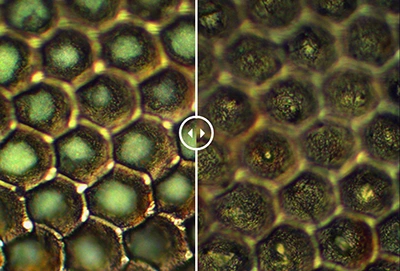
and on the right — after cleaning.
Precise roll rotation and laser-beam travel allow us to tailor the cleaning parameters to any line screen and type of contamination. Our machines clean not only the anilox cells but even the microscopic surface texture on the cell walls. Yet every microfeature remains visible on the ceramic surface after 60 consecutive cleaning cycles on a clean roll. This shows that our process does not alter the roll’s ceramic coating. The roll can be cleaned every day, allowing you to eliminate press downtime caused by contaminated anilox rolls. We protect your investment in anilox rolls. The performance of our machines at 68 customer sites without a single complaint about cleaning safety since 2016 supports this conclusion.