




The evolution of anilox roll laser cleaning. LaserEcoClean.
Faster. Safer. Better.
The text, statistics and equipment specifications are presented as they stood at the time of publication.
In 2013, in our article, we discussed the advantages and disadvantages of anilox roll laser cleaning, compared ultrasonic and chemical methods with the modern LaserEcoClean process, and offered our thoughts on the shortcomings of certain laser cleaning technologies.
In 2014, we are ready to share what we have learnt since then about laser cleaning anilox rolls.
A little history
The history of laser cleaning itself is rather curious. In 1965, the American physicist Arthur Schawlow patented a ‘laser eraser’. Seeking to show the world that lasers could serve purposes other than military ones, he conducted an experiment in which he removed ink from the surface of paper without damaging the paper itself. The same method is still used to restore paintings and works of art.
In 1972, a research team led by John Asmus of the University of California was in Italy recording holograms of damaged Venetian statues. During their work, a conservator approached the scientists and complained about the difficulty of removing contamination from marble. In essence, Asmus repeated Schawlow’s experiment by irradiating dark deposits on white marble. Today, Dr Asmus heads a major organisation specialising in the laser conservation of cultural heritage.
In the 1980s, IBM used laser cleaning to remove submicron contamination from silicon surfaces.
As lasers became more practical — smaller in size and longer-lived — their applications became less exotic:
- in the 1990s, methods emerged for stripping paint and coating systems from railway carriages and aircraft. Laser removal of radioactive contamination from various surfaces also became economically viable;
- in 2003, laser cleaning was used in England to remove fallen leaves from railway tracks. The laser source was installed on a locomotive, and the cleaning speed reached 32 km/h. Until then, every autumn, 3,000 people armed with brushes had been employed to clean the rails;
- in 2014, LaserEcoClean equipment for cleaning anilox rolls will allow the people with brushes in printing companies to be given something else to do.
A little practice. Media-blasting technologies.
We had an opportunity to compare our process with media-blasting methods in corrugated production and with European laser technologies on ‘small’ rolls.
Media blasting for corrugator rolls has two disadvantages:
- in most cases it remains a manual process, which means that uniform cleaning is out of the question;
- after dry media blasting, approximately eight hours must be spent cleaning dust from the production area.
LaserEcoClean cleaning of corrugator rolls from 1.8 to 4.2 metres long follows the same principle as cleaning ‘small’ anilox rolls of up to 1.5 metres:
- the process is fully controlled, with the head aligned and moved relative to the roll to an accuracy of 100 μm;
- the process leaves no cleaning waste.
It should be noted that automated and wet systems for cleaning anilox rolls with granulate do exist and, in theory, are free from the disadvantages described above; we have not, however, had an opportunity to see such systems in operation.
In any event, the principal limitation of media blasting is its inability to clean narrow, deep cells — in other words, high-line-screen rolls with a high cell volume.
Better. Faster. Less expensive.
Three fundamental differences from earlier laser cleaning technologies.
Quality. In the previous article, we set out some theoretical observations on the advantages and disadvantages of certain laser cleaning technologies. In brief, the strength of anilox laser cleaning with a slowly rotating roll lies in its ergonomic and inexpensive roll-rotation system (Fig. 1).
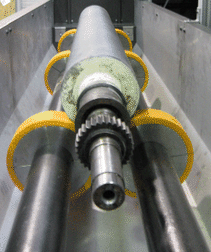
The disadvantages lie in the solid-state laser source. With this type of scanning system, slightly undercleaned and overheated areas may remain on the roll surface: the laser spots overlap either too much or too little. The photographs below show the surface of a roll cleaned using another manufacturer’s anilox laser cleaning equipment.
We photographed the working surface of the roll (Fig. 2), as well as the unengraved surface of the roll at 200× magnification (Fig. 3). The bands produced by uneven cleaning are clearly visible here. We do not believe that artefacts of this kind on the roll surface would necessarily be visible in the printed image; nevertheless, the roll cannot be described as uniformly clean.
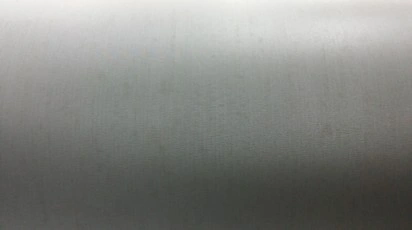
and light, overheated areas is visible.
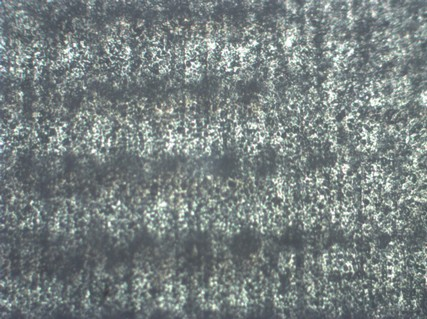
Unengraved edge of the anilox roll. Dark and light areas.
We also photographed the working surface of an anilox roll cleaned with LaserEcoClean technology (Fig. 4), and the edge of the same roll after LaserEcoClean cleaning at 200× magnification (Fig. 5).
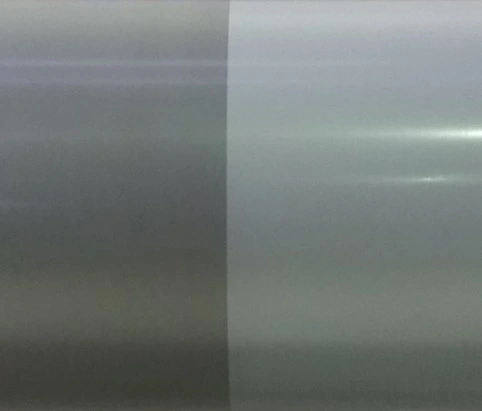
The roll is uniformly clean on the right.
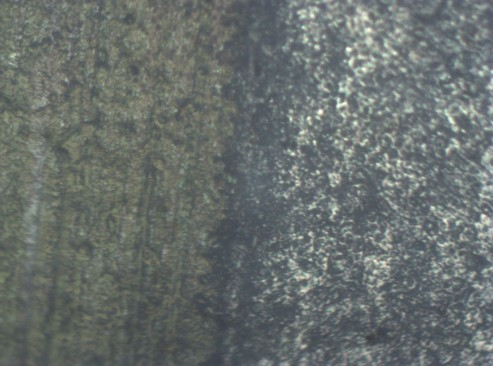
at the unengraved edge of the anilox roll. 200× magnification. The clean area is on the right.
The overlap is minimal and, in practice, imperceptible.
Speed. According to our calculations — and once the spot size is known, they are not difficult to make — deep-cleaning a roll with a working face 1,360 mm long takes around two hours when the technology relies on slow roll rotation. Cleaning one 1,360 mm roll with LaserEcoClean takes 38 minutes. Cleaning six rolls before a print run, including the time required to remove and reinstall them, takes four hours.
Economy. Anilox roll laser cleaning equipment using LaserEcoClean requires neither a three-phase power supply nor water cooling. The equipment uses no consumables. The laser source is rated for six years of continuous operation. For a printing company with a fleet of around 100 anilox rolls, we forecast a payback period of three years, achieved through lower expenditure on cleaning chemicals, reduced pigment consumption and longer roll life.
We stand behind our words
Before entering the anilox cleaning market, we had to make sure that the technology we had developed was safe for every type of anilox roll.
The diagnostic system we initially used for our own purposes became one of our technology’s principal competitive advantages. After every cleaning, we provide before-and-after photographs of the cells — both the cell floors and the walls — at magnifications of up to 800×. We also measure the roll’s line screen and cell volume.
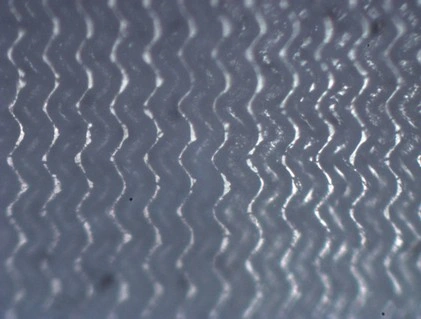
The dirty area is on the left. Both the cell walls and the cell floors are in focus.
200× magnification.
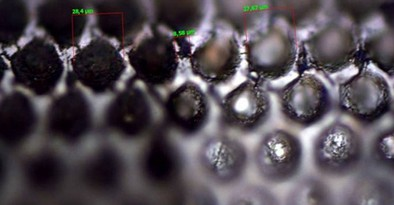
The dirty area is on the left. Both the cell walls and the cell floors are in focus.
400× magnification.
We are a company that has tracked the condition of customers’ anilox rolls in photographs after four years of regular cleaning. We accept contractual liability for preserving the ceramic surface of every roll we laser-clean.
Perhaps that is why some of the world’s largest printing companies have entrusted us with cleaning their entire anilox fleets.
Annual cleaning. Opinions.
Many flexographic specialists believe that cleaning anilox rolls once a year is pointless because, after two or three months, a stable quantity of contamination accumulates on the cell floors, determined by the printing parameters, the inks used and the daily cleaning system. We disagree.
We repeatedly clean complete anilox fleets for large companies, at intervals of nine to fourteen months. Our experience shows that rolls which have never undergone deep laser cleaning are much harder to clean — forcing us to use more powerful settings — than rolls which have already been laser-cleaned at least once, for which we can use gentler settings.
On the floors of cells that have never been deep-cleaned by laser, deposits may accumulate and harden until they are almost stone-like. At that point, the loss of ink transfer becomes irreversible.
For every job, we keep records based on the roll numbers. In addition, at one edge of each roll, outside the working area, we leave a row of 10–15 cells uncleaned; this makes a laser-cleaned roll easy to distinguish from a dirty one, since the uncleaned cells are always darker, and helps the printer find their bearings. When we return a year later, the strip we left behind is still visible. The difference can be seen with the naked eye and confirmed by measurement. This shows that the anilox cells accumulate far less contamination in one year than they do over two or three years.
For printing companies with fewer than 60 rolls, where purchasing our equipment would not be economical, we therefore recommend deep laser cleaning at least once a year. Better still, monitor changes in ink transfer using test prints and call in a cleaning service when a significant reduction occurs.
Weekly cleaning. The rules of perfect printing.
One view is that a good print depends on four rules:
- high-quality colour separation and its accurate reproduction on the plate cylinder;
- a clean ink system and clean anilox rolls;
- properly prepared ink;
- and skilled people throughout the process.
We believe that using an absolutely clean anilox roll for every print run is the dream of every production plant. It became possible when we created LaserEcoClean, a fast and safe laser cleaning process. Today, we guarantee that rolls can be cleaned weekly on our equipment.
LaserEcoClean is one of the four rules of perfect printing.
Daily cleaning. It could not be simpler.
We are often asked: ‘You have seen a great many production plants. What product should we use to keep the cells in perfect condition?’ The answer is almost too simple to believe. Of the 140 plants at which we have worked, we have seen only three whose rolls were close to perfect, with minimal contamination. Yet the cleaning products used there were the same as everywhere else.
What set those plants apart was one rule: the anilox roll had to be washed after every print run.
In other words:
- painstaking work every day;
- a managing director who motivated the production manager;
- a production manager who required the process engineer to keep watch over the rolls;
- and press assistants standing by with brushes, scrubbing the roll after every print run.
Value the work of the ‘cleaners’. Live in peace. Take care of every aspect of your production. And if you have more than 60 anilox rolls, replace the people with brushes with a safe anilox laser cleaning system.