




Frequently Asked Questions About Laser Cleaning of Anilox Rolls
No. The LaserEcoClean process uses thermomechanical removal of contamination. Short laser pulses heat organic and polymer contaminants much faster than the ceramic layer of the roll. This breaks the adhesion between the contamination and the ceramic surface. The visible plume consists of detached particles above the ceramic surface. Smoke and residual dust are extracted from the cleaning zone and filtered inside the machine.
A laser can damage an anilox ceramic layer if the cleaning parameters are selected incorrectly.
For this reason:
a) we spent a full year developing safe cleaning parameters before commercial use. In 2013, the process was fully automated and developed into LaserEcoClean technology;
b) we developed precision equipment with positioning accuracy down to 50 µm, allowing the specified cleaning mode to be maintained over roll lengths of 2,900 mm and more;
c) our team includes specialists in laser and printing technologies;
d) LaserEcoClean continuously controls the cleaning process and is designed to provide safe, repeatable cleaning;
e) every roll can be documented before and after cleaning so that the result and surface condition are traceable.
No. The laser spot is approximately 100–130 µm, so several cells are cleaned simultaneously depending on the roll line count. Correctly selected cleaning parameters allow contamination to be removed from the cell bottoms without damaging the cell walls.
No, when the cleaning parameters are correctly selected. Contamination removal occurs at approximately 400–600 °C. Ceramic melting occurs at approximately 2,435 °C, while ceramic ablation during laser engraving requires substantially higher temperatures.
Before a LaserEcoClean system was installed at Zecher GmbH in 2016, the cleaning process was examined there using an electron microscope.
We have also repeatedly performed clean-roll tests for customers. These tests showed that a clean roll can be processed 60 times or more without visible damage to the ceramic layer when the correct LaserEcoClean parameters are used.
We remove contamination not only from the cells but also from cavities and surface irregularities. After cleaning, the roll is free from polymer and organic contamination, apart from normal wear and mechanical damage accumulated during operation.
How quickly dried ink builds up again depends on:
a) the daily wash-up system used on the printing press;
b) how consistently weekly and monthly anilox maintenance is performed;
c) ink types and run lengths.
If the roll manufacturer’s daily, weekly and monthly cleaning recommendations are followed, deep cleaning may be required only about once a year. For plants using their own LaserEcoClean system, the entire roll inventory can be cleaned more frequently. We recommend cleaning the fleet 3–4 times per month where operationally appropriate.
LaserEcoClean designs and manufactures its own equipment for deep laser cleaning of anilox rolls and sleeves.
Yes. We have provided anilox roll laser cleaning services since 2010, and many printing companies use the service repeatedly. The interval between deep-cleaning visits depends on ink systems, press operation and routine anilox maintenance; for many customers it is approximately 9–13 months.
Ultrasonic and jet-cleaning methods such as dry ice or soda are contact or impact-based processes and may place additional mechanical stress on the anilox surface. They can also differ from laser cleaning in cleaning performance depending on cell geometry and contamination.
Chemical cleaning is also a contact process. Surface tension can make it more difficult for liquids to penetrate narrow, deep cells on high-line-count rolls. See our comparison of chemical and laser cleaning.
Contact us with the number of rolls, their dimensions and your location, and we will recommend the most practical option.
For a small number of rolls, shipment to a LaserEcoClean service location may be the simplest solution. For larger roll inventories in Europe, mobile laser cleaning may be more economical: mobile anilox roll cleaning.
For printing plants with approximately 40 anilox rolls or more, an in-house LaserEcoClean system may be the most practical long-term solution.
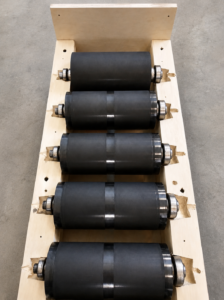
We recommend shipping anilox rolls in wooden or plywood crates.
The roll journals must be securely fixed so that the roll cannot move inside the crate.
The ceramic surface must be protected with a suitable sleeve or protective covering.