




02. What is an anilox roll?
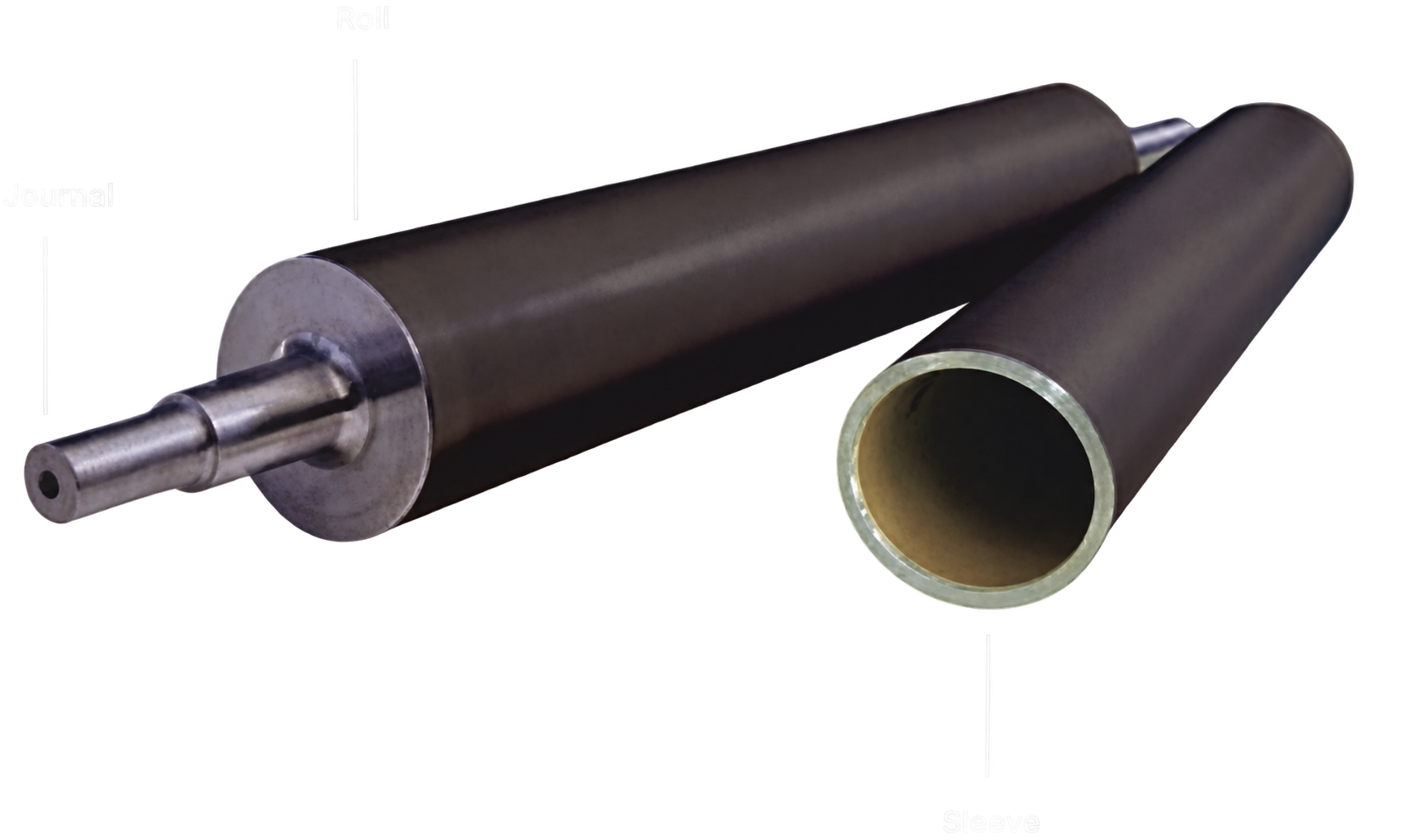
Anilox rolls are produced in two main forms:
- An anilox sleeve is a hollow cylinder with an aluminium body and a ceramic coating approximately 300 μm thick. With few exceptions, sleeves weigh no more than 40 kg. They are the modern form of anilox: lighter and easier to handle than a solid anilox roll;
- An anilox roll is a steel cylinder with journals, also coated with a thin ceramic layer. These rolls weigh between 50 and 200 kg. This traditional and widely used design is heavier and less convenient to handle.
Purpose of an anilox roll
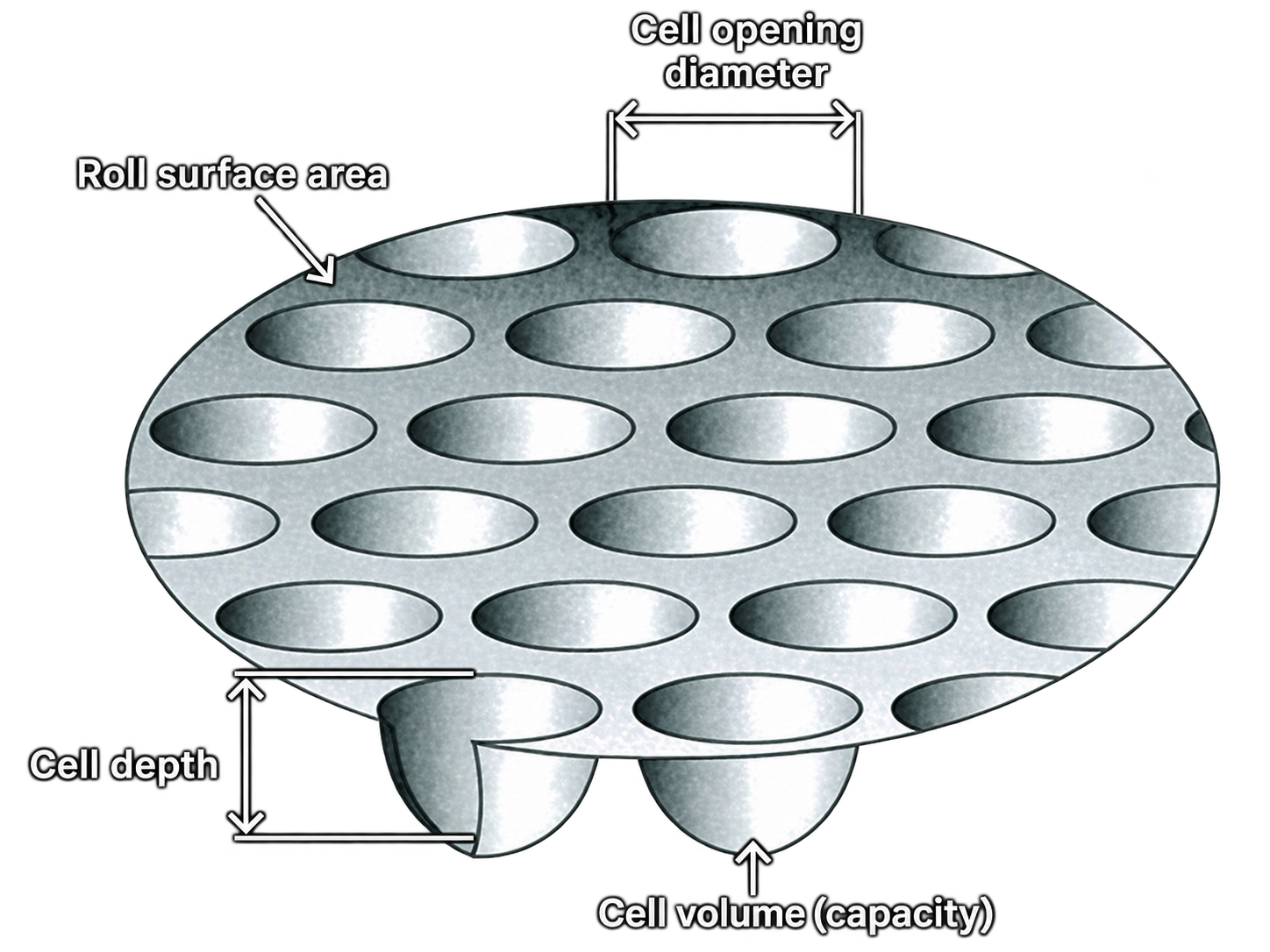
An anilox roll meters a uniform ink film from the ink chamber onto the flexographic plate and then onto the substrate. It has a thin ceramic coating, approximately 300 μm thick, in which the cells are laser-engraved.
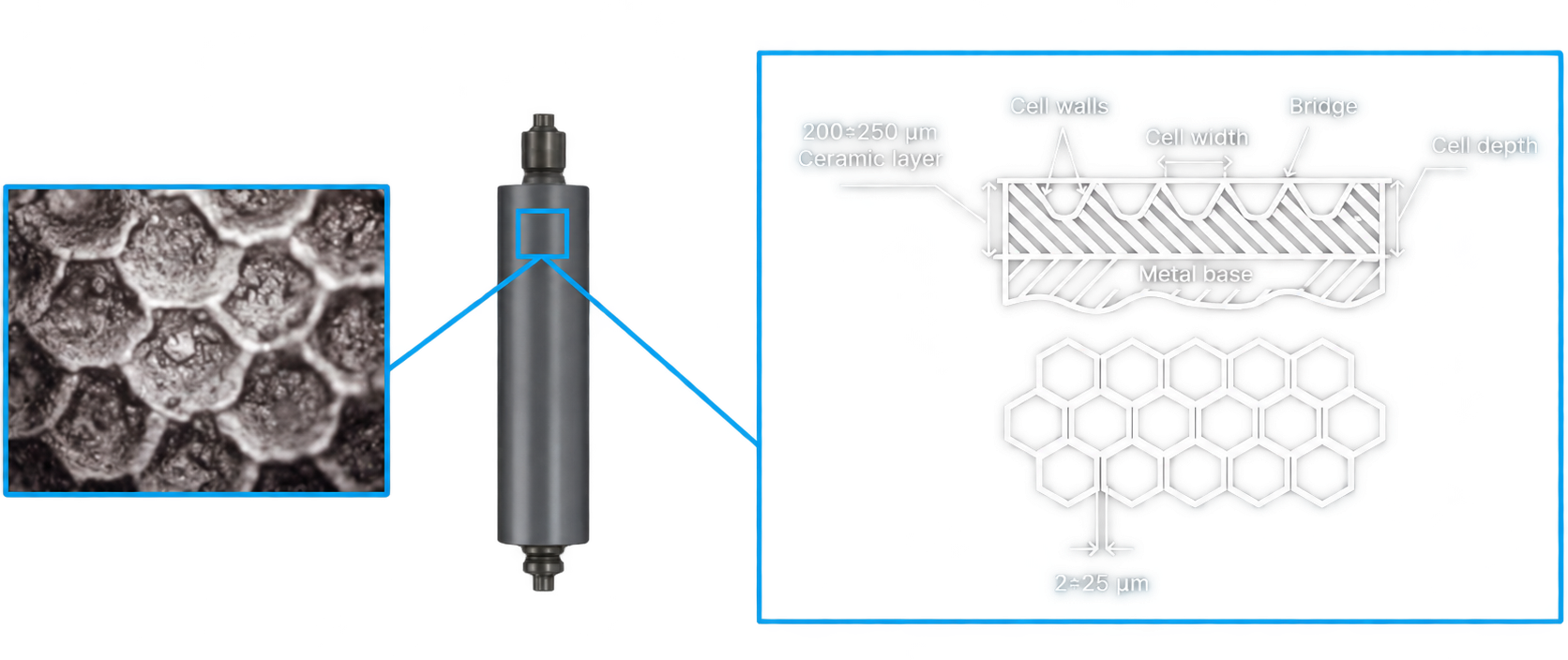
The most common cell-opening diameters range from 25 to 120 μm. Cell depths range from 8 to 50 μm, and cell-wall widths from 5 to 20 μm. The principal anilox specifications are line screen and cell volume. In Europe, line screen is expressed in lines per centimetre (lpcm); in the United States, it is expressed in lines per inch (lpi). Cell volume is expressed in cm³/m² in Europe and in BCM (billion cubic microns per square inch) in the United States. To convert a value in cm³/m² to BCM, divide it by 1.55.
Anilox roll line screen
An anilox roll’s line screen is the number of cells per unit of length, either a centimetre or an inch. One cell pitch comprises the cell-opening diameter plus the cell-wall width. The simplest method is to measure the centre-to-centre distance between two adjacent cell walls, as shown in the illustration.
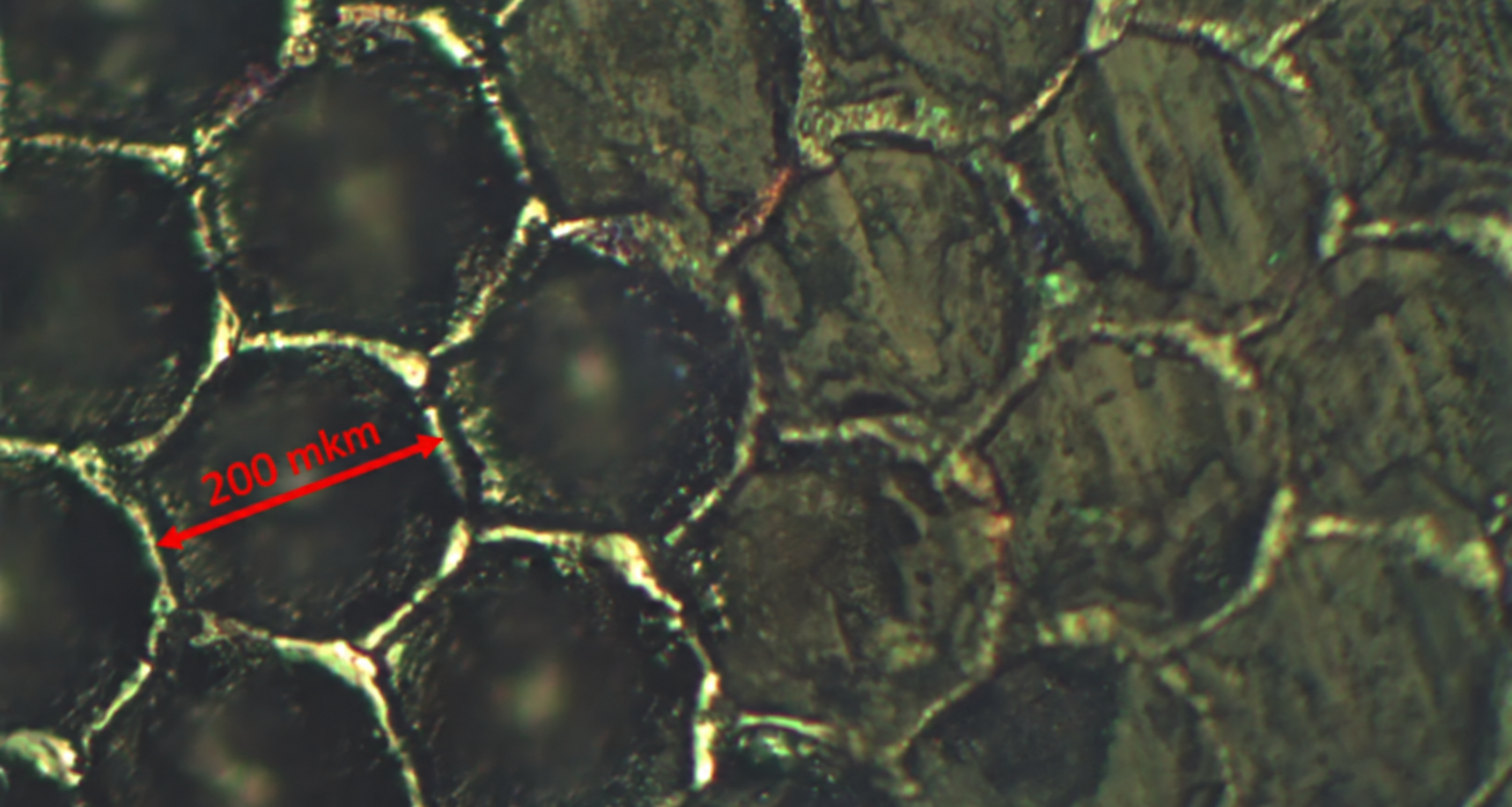
In the image above, the centre-to-centre distance between the cell walls is 200 μm, so the roll’s line screen can be calculated as follows: 10,000/200 = 50 lpcm.
If we know the cell diameter, depth (50 μm) and geometry, we can calculate the volume of one anilox cell by approximating its shape as an elliptic paraboloid. The resulting cell volume is 5.6 × 10⁻⁷ cm³, giving a cell volume of 15.5 cm³/m² for the roll, or 10 BCM.
LaserEcoClean can clean rolls with line screens above 560 lpcm without damaging the ceramic surface.
LaserEcoClean supplies anilox rolls and sleeves manufactured in the EU and China.