




We know how to melt anilox rolls
The text, statistics and equipment specifications are presented as they stood at the time of publication.
I am pleased to welcome readers to the theoretical section of our website on anilox roll laser cleaning. Let me remind you that we appear to build the finest anilox cleaning machines in the world, while you, the reader, are taking part in the printing process in different corners of the world, working for the finest companies in the world. And since we have all come together on opposite sides of this screen — I in the form of letters and you in the form of a pair of reading eyes — let us see whether we can learn something new.
The principle of laser cleaning has not changed in the time since the previous article was written. A short laser pulse heats materials with different thermal conductivities at different rates. If the materials have become ‘baked’ together, rapid heating breaks their adhesion, causing contamination with the higher thermal conductivity to detach and be ejected from the surface with the lower thermal conductivity. With pairs such as ‘ceramic–ink’ or ‘iron–rust’, this works perfectly. Removing contamination from rubber or polyamide surfaces remains ineffective. In short, all is stable in the world of cleaning. The laws of physics run like clockwork.
The markets in which we operate have been equally stable.
In Germany, 120 of the country’s 450 printing companies entrust us with their cleaning (27%); in Italy, 50 out of 300 (17%); and in France, 30 out of 167 (18%).
We sold one of our mobile cleaning systems to Australia. I hope Australian rolls can now look forward to a clean and safe future. We are planning to open a mobile service operation in the United States in early 2021.
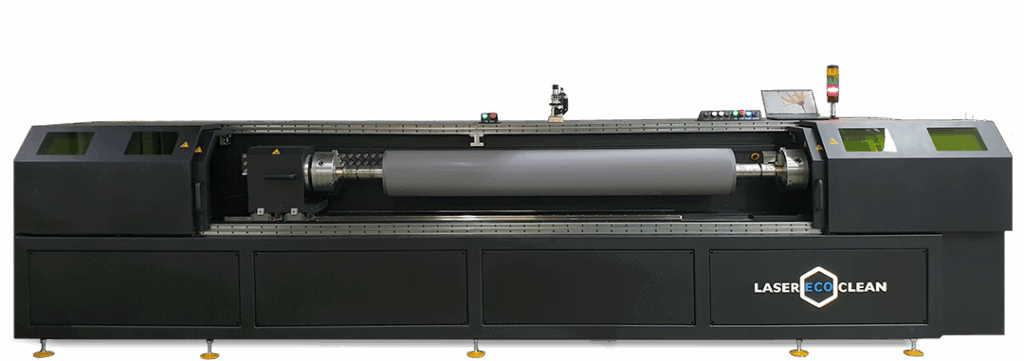
And so our little roll-cleaning service makes its way around planet Earth. Meanwhile, we have learnt to build heavy-duty stationary systems for laser cleaning anilox rolls (Fig. 1). One thing we can take pride in is a machine capable of rotating anilox rolls weighing up to 600 kg so quickly and so precisely that it can clean one metre of roll in ten minutes — no small print, no qualifications. We really do clean one linear metre of anilox in ten minutes, regardless of the inks or coatings you use. And we do so in a fully automatic cycle, backed by a safety guarantee written into the contract. The operator enters one letter, one number and presses START.
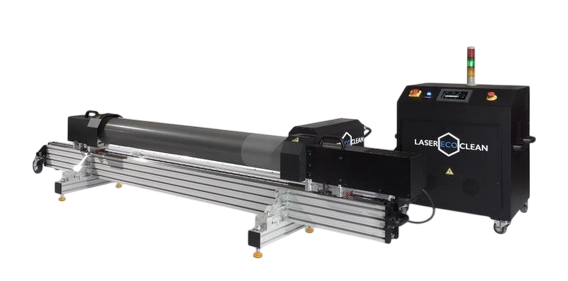
For the US, Canadian and Mexican markets, we also developed a new mobile machine capable of cleaning rolls weighing up to 200 kg at a speed of one linear metre in ten minutes (Fig. 2).
Safety
On a global scale, we work in a very small market. Every customer is vital to us. That is why, from the outset, we have paid the closest possible attention to cleaning safety. This is what sets LaserEcoClean technology apart from competing technologies.
If you have heard negative comments about our technology, write to me.
60 consecutive cleaning cycles
How do you convince people that your particular cleaning technology is safe when many of them have worked as production managers, chief engineers, process engineers and managing directors for longer than I have been alive?
The idea came from prospective customers. They proposed the following experiment: clean an anilox roll 60 times in succession. If the surface does not melt, the technology really is safe.
The experiment did not strike me as particularly true to life, since cleaning a clean anilox roll makes no sense from any point of view. If you are cleaning a clean roll 60 times in a row, something has gone rather wrong with the way work is organised at your plant. But I understood that the experiment had to be done. Any explanation of why the task made no sense would merely suggest that we were afraid to put the technology to the test. Still, I was genuinely uneasy.
Back in 2010, I had already conducted safety tests on laser cleaning for anilox rolls. I cleaned one roll 40 times, but before each cleaning cycle I applied ink to its surface (see the 2010 article). All of the laser energy was absorbed in removing contamination from the surface, and with the parameters set correctly, no melting occurred (Figs. 3a and 3b).
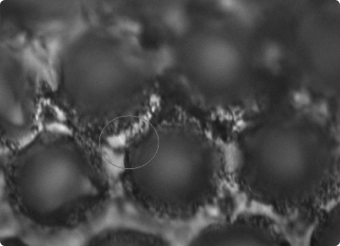
Before each cleaning cycle, the roll was coated with ink.
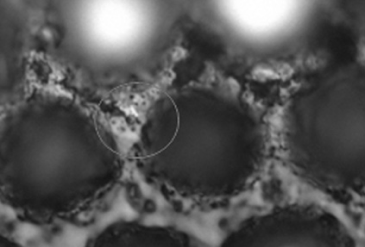
Even with a well-adjusted laser system, cleaning the bare surface of a clean anilox roll directs the energy into heating the ceramic, and melting may occur. In the equipment manual, we expressly prohibited the cleaning of clean rolls. Since our machine remembers every roll it has ever cleaned and stores these data in the cloud, we also programmed it to display a warning if the same roll is cleaned more than once within two or three days. With that, we put the matter to rest.
But in 2020 the gauntlet was thrown down. Ten years earlier, I had spent several days on the experiment, hunched over a microscope; this time, we wrote a program for one of our machines, installed a dirty roll, started the cleaning cycle and went to lunch.
How the experiment was conducted
We took a roll that had never been laser-cleaned. We selected the ‘Classic’ cleaning mode installed on all our stationary machines and photographed the cells before laser exposure. A program was written to clean the roll automatically 60 times. The first pass removes all contamination from the cells; every subsequent pass acts directly on ceramic that has nothing to shield it from the laser beam. After 60 passes, we compared the roll under a microscope before and after cleaning. The interesting point here is that we have more than ten years’ experience assessing laser-induced damage to anilox rolls. Our inspection rule is as follows: after laser cleaning — in this case, after 60 cleaning cycles — the anilox surface viewed at 400× to 800× magnification must be indistinguishable from its surface before cleaning. We know how a roll melts, but for those who do not, here is what happens. As laser power is increased gradually, the smallest features on the cell-wall surface begin to fuse into larger structures. The walls progressively lose their roughness and the ceramic becomes smooth and ‘mirror-like’. If the power is raised further, the cell walls themselves begin to melt and lose their shape: they grow wider, while the sections between the cell junctions begin to sag. A cell junction is the point at which three walls meet. Increase the power still further and the hexagonal structure breaks down completely, after which ceramic ablation begins — the roll has been ground smooth and is ready to be made into a new anilox.
So, we cleaned the same area of the roll 60 times. The roll had a line screen of 300 lpcm and a cell volume of 4.9 cm³/m² (Figs. 4a and 4b).
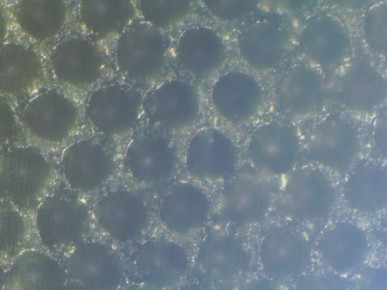
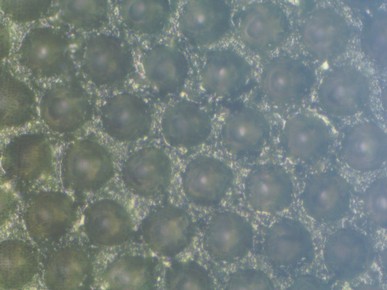
All of the laser energy went into the ceramic.
The result surprised me. I had sincerely expected continuous cleaning of an anilox roll to produce at least minute changes in the ceramic structure, smoothing its finest surface features. Yet no such changes occurred. I shall permit myself the conclusion that if nothing changes after 60 cleaning cycles on a clean roll, nothing will change after 200 either. Our ‘Classic’ mode can therefore clean anilox rolls safely any number of times, without restriction. If the thought that we might be cheating has crept into your mind, we filmed the entire process in one uninterrupted take. If you would like to watch 40 minutes of a roll being cleaned by laser, write to me and I will send you the link. On the video platforms, we are already competing with two hours of a burning fireplace and five hours of a stream flowing through a forest.
Nevertheless, I remained convinced that cleaning a clean roll ought to make it melt. So we began searching for the parameters at which melting would finally occur.
The settings changed, the machine obediently cleaned the clean roll, and the before-and-after images were carefully filed away. As the photographs show (Fig. 5), gradually increasing the power density from ‘Mode 1’, which we use for daily cleaning, to ‘Mode 2’ or ‘Mode 3’ does not cause melting.
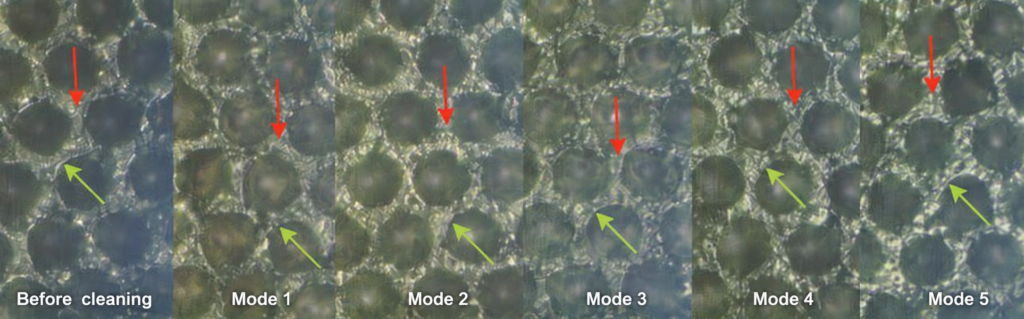
followed by 60 cleaning cycles on the clean roll as the power density (ρ) is increased
from ‘Mode 1’ — the classic daily-cleaning mode, in which ρ is at its lowest —
to ‘Mode 5’, in which ρ is at its highest.
We can see that the cell walls retain their finest surface roughness, marked by the red arrows, and that some cells have a perfectly circular outline, marked by the green arrows. This means that the first three modes can — and will — be used for routine cleaning. In the photographs for Modes 4 and 5, however, the smallest features on the walls can be seen fusing into larger structures, as indicated by the red arrows. All the cells also lose their regular shape, as shown by the green arrows.
We use the final cleaning mode only on rare occasions, for exceptionally difficult rolls that have not been cleaned of white two-component inks for many years. A roll that requires these settings usually cannot be rescued by any other method. Nevertheless, as Figs. 6a, 6b and 6c show, a single cleaning cycle in this mode is possible.
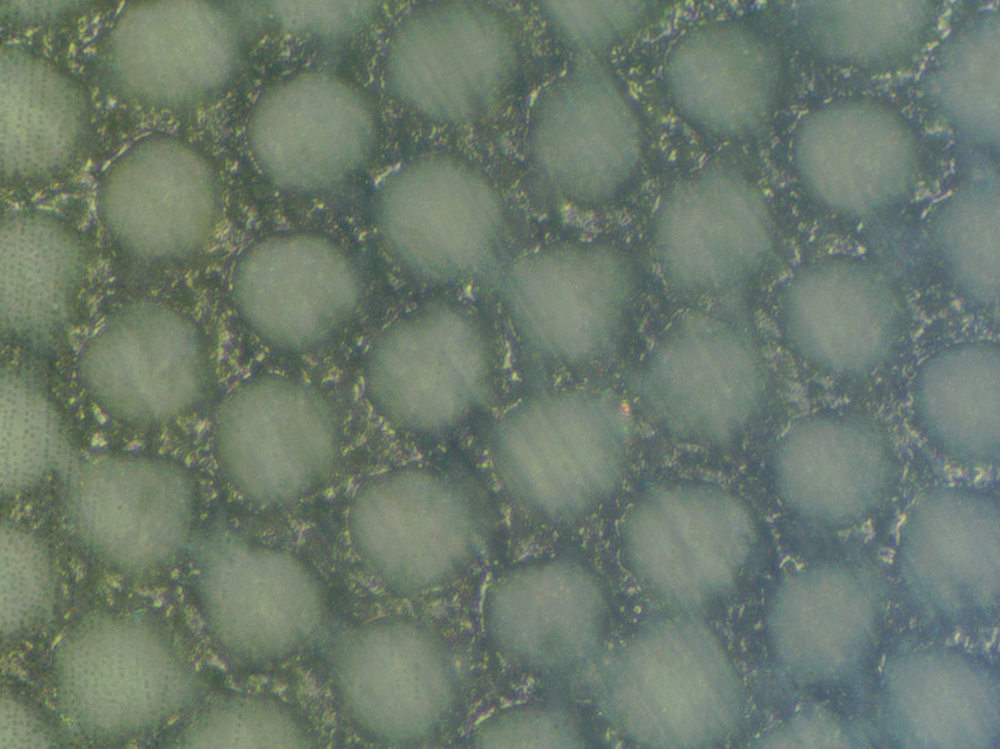
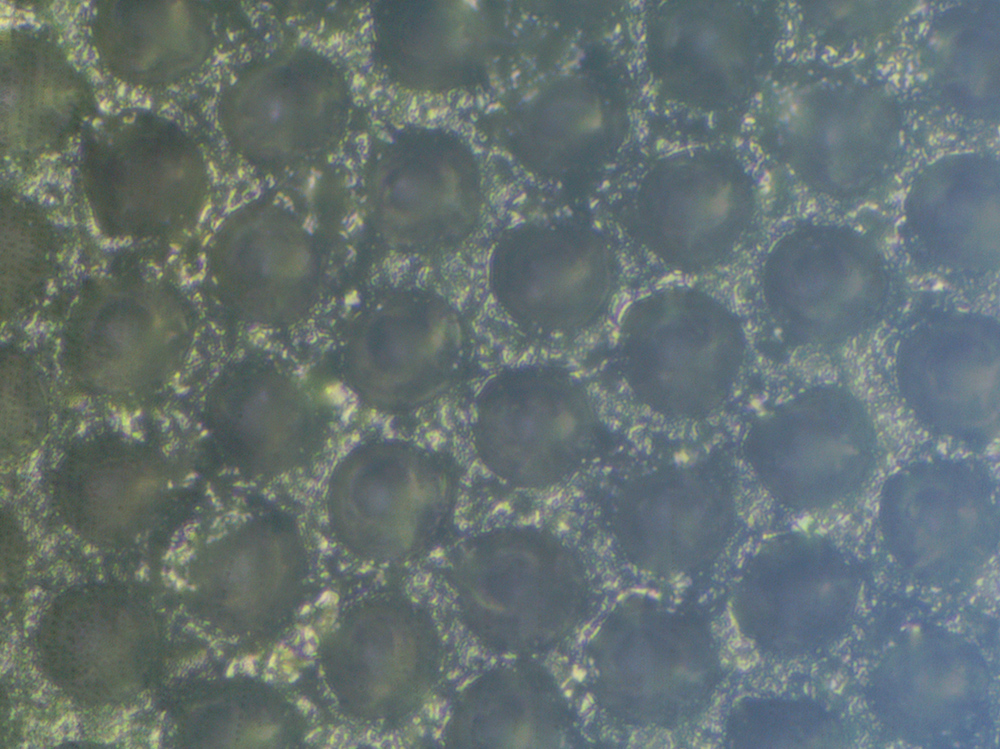
(acceptable result).
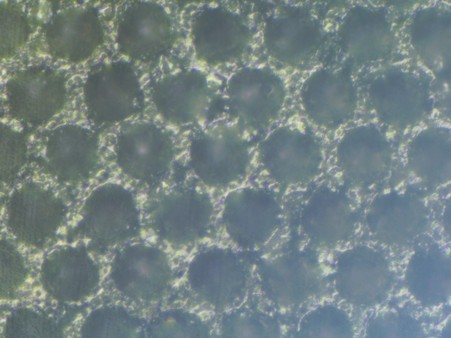
(unacceptable result).
If the roll has been used for printing, or has been lowered into the ink tray between cleaning cycles, even the most aggressive settings can be used repeatedly with our technology. No difference can be seen before and after a single cleaning cycle. This mode does not, however, pass the test of 60 cleaning cycles on a clean roll. Such settings must therefore be used with care.
It is worth noting that, although we do not use this mode for daily cleaning, the hexagonal structure remained visible on the anilox surface even after 60 cycles, and the cell depth did not change. This means that if you examine a roll which, in our view, has melted in this way using a Troika microscope, you will see no difference in its measured cell volume.
How thermal damage occurs after some beam-scanning processes are used
First pass. Figure 7. The red circles mark areas of melting. The rough features on the cell walls melt, the surface becomes smooth and mirror-like, and it begins to reflect more light. After the second pass, almost none of the original wall roughness remains (Fig. 8).
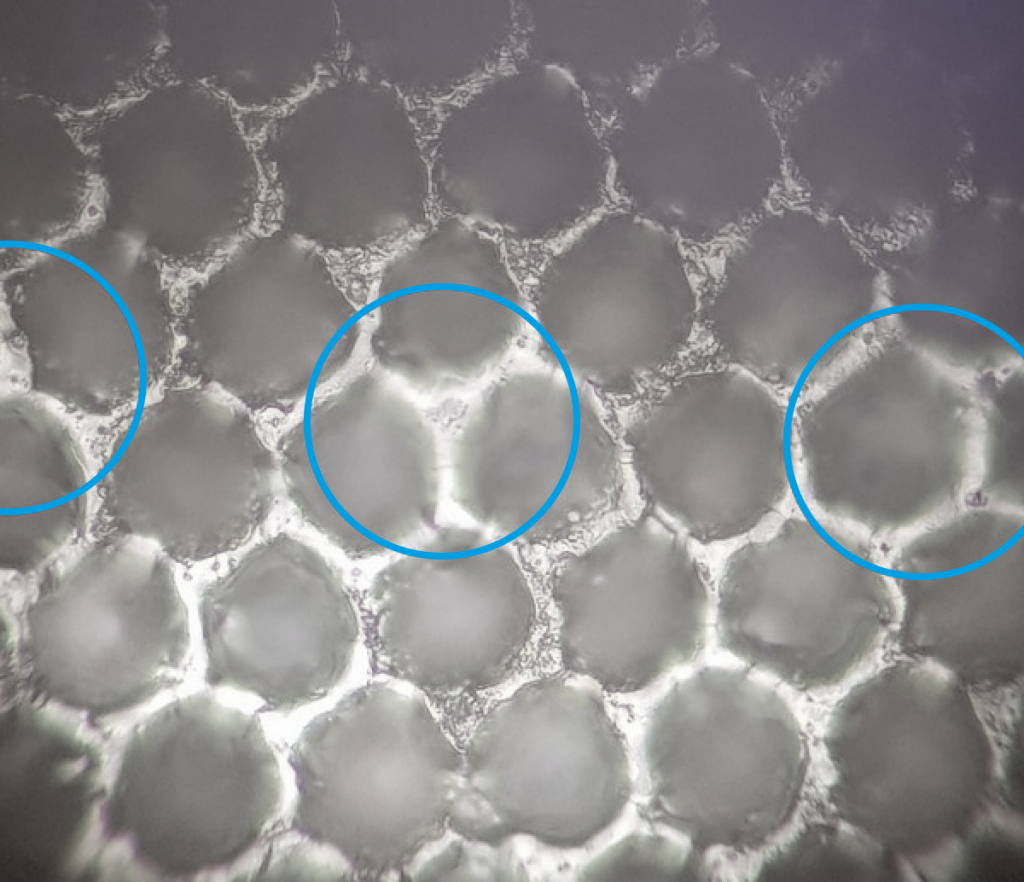
in which the cell walls have melted.
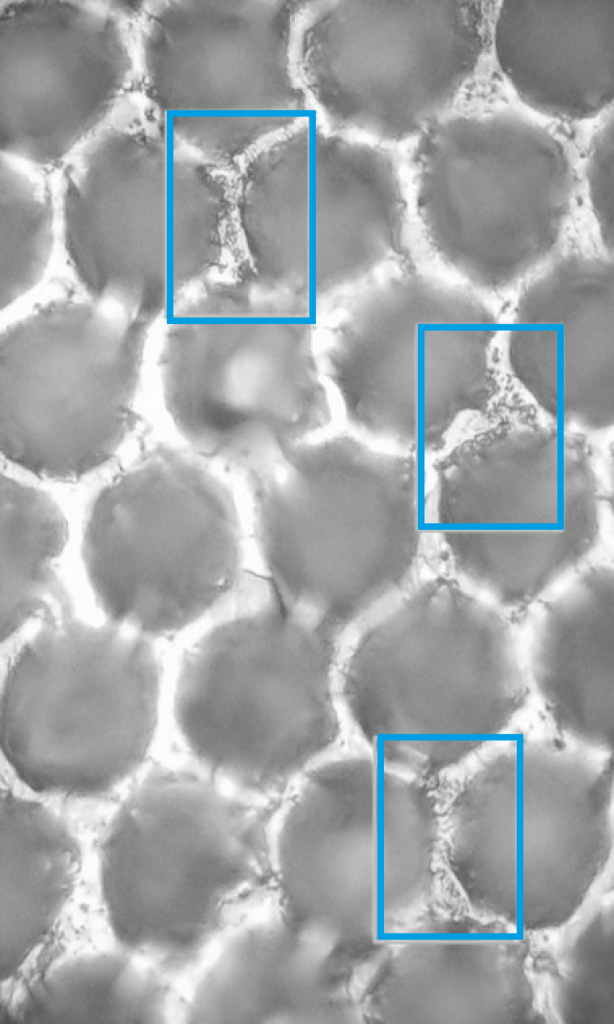
Rolls after several years of cleaning are shown in Fig. 9a. The Troika system began to record a reduction in cell volume. Figure 9b shows an area of the roll that was not exposed to laser radiation.
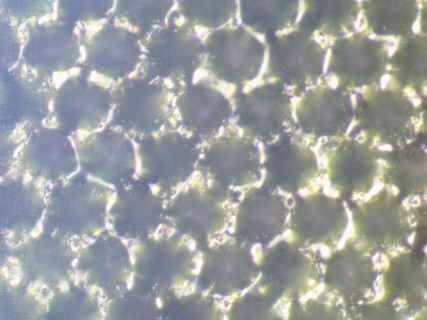
after 20–30 cleaning cycles.
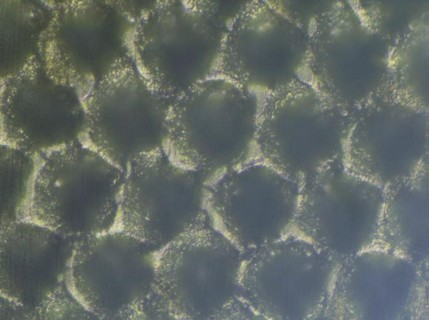
The fundamental difference lies in the precision of the technologies. We rotate the roll at high speed and position the laser beam so that every pulse is placed with minimal overlap along both the X and Y axes. We also use a precision roll-rotation system and maintain parallelism between the carriage travel and the roll’s axis of rotation to within tens of micrometres. Together, these measures allow us to form a laser spot with the same power density along the entire length of the anilox surface. In beam-scanning technologies, positioning a single laser pulse precisely at one point on the roll is more difficult (Fig. 10).
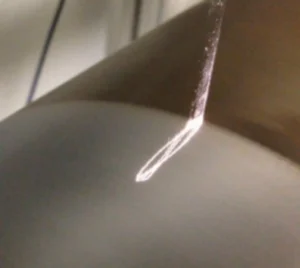
Multiple overlapping pulses strike the same point.
In the technologies we studied, each point receives between three and fifteen pulses. Combined with incorrectly selected settings, this may cause a roll to begin melting after the first two passes and become completely unusable within one or two years.
What conclusion can we draw?
We build a machine that can deep-clean anilox rolls every day without damaging the ceramic. And we guarantee that in the contract.
For those who remain unconvinced by words alone, we recommend testing any other technology by running dozens of cleaning cycles on a clean roll, and insisting that the contract clearly assigns responsibility for your anilox fleet. Any technology, including ours, is dangerous when used incorrectly.
For our part, we now understand the safety limits of our equipment far more precisely and can answer any questions you may have with confidence.
In ten years, we cleaned 50,000 rolls and sold 33 machines in more than eight countries: the United Kingdom, the United States, Mexico, Germany, France, Poland, China and Australia. For ten years, we have put our own heads on the line for the hundreds of thousands of euros you have invested in your anilox rolls. Because we know how to melt anilox rolls. And, unlike some of our competitors, we also know how not to melt them. That is the whole secret. Thank you for the time you have spent reading this. I hope we made you smile at least once. Stay well.