

03. Why anilox rolls need cleaning
To understand why printing companies clean anilox rolls, we first need to understand how an image is formed on the substrate.
Leaving aside the details of halftone screening and colour mixing, the process is easiest to explain with a simple example.
Suppose we need to print an array of red dots onto white polyethylene film.
On the printed substrate, the human eye perceives this array of dots as a solid red area.
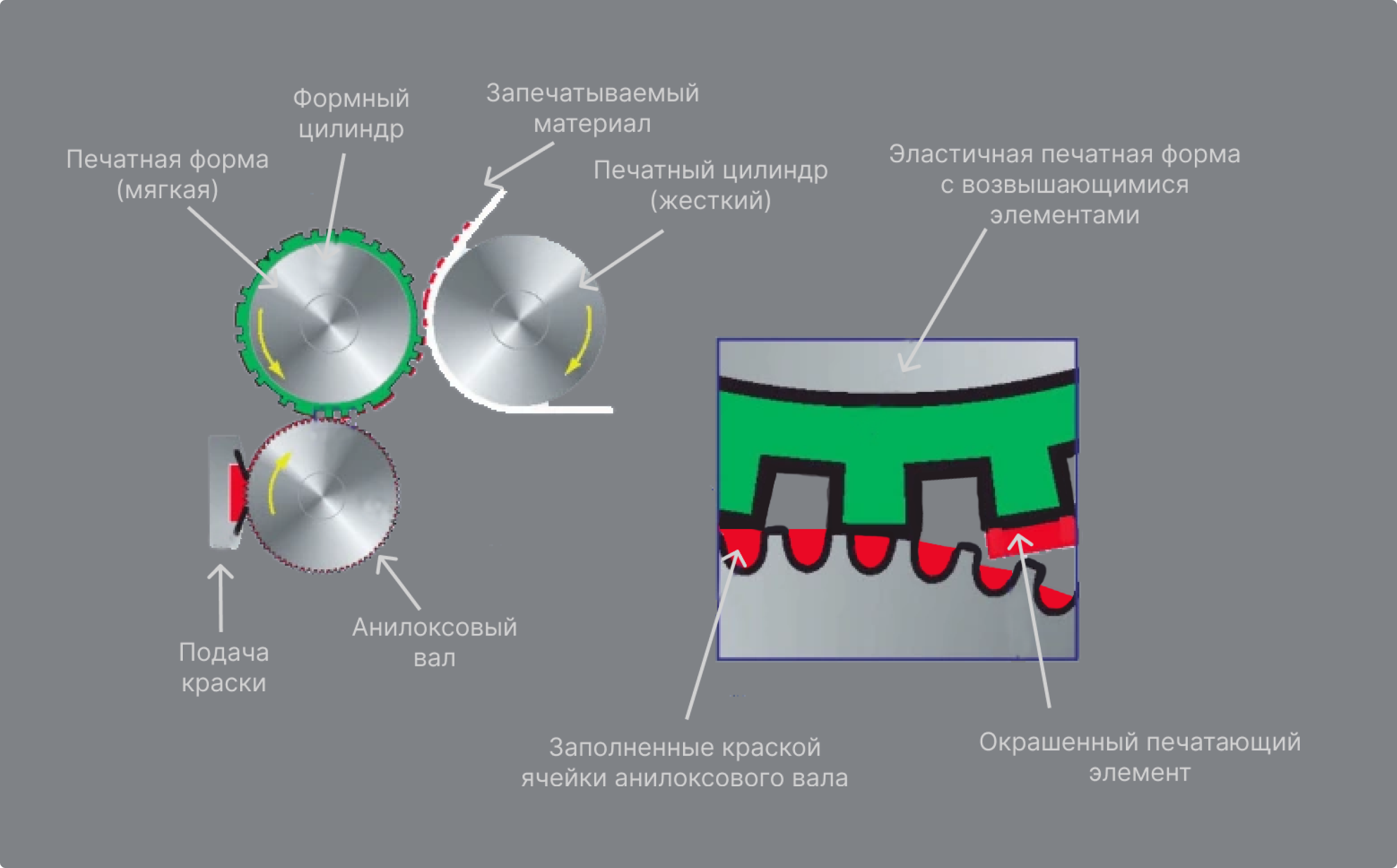
In practical terms, the press operator loads red ink into the flexographic press. The ink is pumped under pressure into the ink chamber, where it fills the anilox cells. Let us assume that the cells are 40 μm deep. As a rule of thumb, 50% of the ink in a cell is transferred to the plate, and a further 50% is transferred from the plate to the substrate. With a cell depth of 40 μm, this would produce an ink film approximately 10 μm thick on the substrate. Actual ink transfer, however, depends on the anilox specifications, ink, printing plate, substrate and press settings.
During printing, the anilox roll rotates continuously and the ink inside its cells remains liquid. When an operator removes an anilox roll from the press, the ink should be cleaned from the cells immediately by whatever suitable method is available. Our inspection results show that if cleaning is delayed, a 1–2 μm layer of dried ink remains at the bottom of the cells. Without careful maintenance, cell capacity may become restricted by 30–50% over the course of a year. As a result, the halftone dots on the substrate may carry a 5–7 μm ink film instead of the expected 10 μm. Red may appear pink, blue may appear pale blue, and so on. In other words, optical density and colour saturation fall, making the printed result appear lighter.
Fresh ink also adheres more readily to dried ink residues at the bottom of a cell. A contaminated roll therefore becomes fouled more quickly than a roll that is kept clean. A thoroughly cleaned roll maintains stable ink transfer for longer.