




Clean anilox rolls today.
Every day, every month, all year round.
The text, statistics and equipment specifications are presented as they stood at the time of publication.
Three years ago, when discussing deep cleaning for anilox rolls, we compared the conventional methods — ultrasound, chemicals and granulate — with what was, for us, a new way of cleaning anilox rolls: the laser.
Today, we can say that the method has established itself. Our first customers have already had every roll in their fleet cleaned three or four times. After trying the process on one or two rolls, many large printing companies with fleets of 20 to 100 rolls or sleeves decided to have the entire fleet cleaned. Most printing companies have between five and ten rolls cleaned at a time.
We clean rolls directly at the production site using our mobile service; work with offset printers on their coating rolls; remove adhesive and coating from chrome-plated rolls; and clean gravure cylinders, fire-damaged rolls and rolls used in corrugated production.
In this article, I would like to discuss not only the advantages of anilox roll laser cleaning, but also its finer points and its disadvantages.
Types of anilox roll laser cleaning
Several laser cleaning solutions are currently available in Europe.
When we began working on anilox roll laser cleaning, we did not study our competitors’ technologies; instead, we developed equipment whose design differs from every existing alternative.
Several types of anilox laser cleaning equipment are now available on the market:
- a process based on laser beam scanning;
- a process in which the roll rests on rotating rollers and contamination is removed with a laser beam focused to a large-diameter spot;
- and our patented equipment, designed on the principle of a lathe. A roll or sleeve of any size and weighing up to 150 kg is held between the headstock and tailstock, rotated at a fairly high speed and cleaned with a small laser spot.
The disadvantage of cleaning an anilox roll by scanning the laser beam is the difficulty of controlling how many pulses reach each point on the roll. This results in uneven heating of the ceramic.
The advantage of this technology is that it can clean heavy rolls weighing more than 150 kg, as well as rolls that are difficult to remove from the press and therefore have to be cleaned in situ.
Cleaning an anilox roll on slowly rotating support rollers does not permit the use of a small laser spot, as the process would take too long. With a large laser spot, however, achieving a uniform energy distribution across the spot is difficult. Nor can a large spot scan the anilox surface rapidly without overlaps, once again producing uneven heating of the ceramic. The advantage of this technology lies in its ergonomic, simple and inexpensive roll-rotation system. Its limitation is the difficulty of ensuring uniform energy distribution and controlling pulse overlap.
The technology we offer is based on low-threshold thermomechanical removal (LTTR). This regime breaks the adhesion between materials with different thermal diffusivities — ceramic and ink, or ceramic and coating, for example. When the contamination is heated rapidly, a shock wave forms and ejects fine particles of ink from the cells. The particles burn in the laser radiation just above the anilox surface, producing what we call the plume.
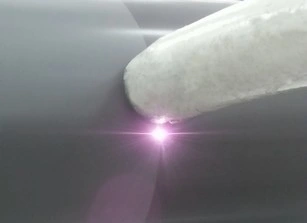
The cleaned area is on the left. On the right is the dirty roll.
The ink residues — dust and a small quantity of smoke — are filtered and removed from the cleaning zone. Heating of the cell walls in this laser cleaning mode is minimal. The laser we use to remove contamination from the roll cells — a fibre laser with a service life of more than six years of continuous operation — is the same type of laser used to ablate ceramic when anilox rolls are manufactured. Ceramic ablation occurs at a temperature of 4,000°C; melting occurs at 2,435°C; cleaning in LTTR mode — 250–500°C. To clean an anilox roll safely and uniformly, we configured the laser scan so that contamination at every point on the roll is removed specifically in the thermomechanical regime, taking account of the non-uniform energy distribution within the laser beam.
To achieve this, we had to build equipment with minimal runout as the roll rotates, limit deviation from the laser focus — the beam waist — to 50 μm, and coordinate the roll feed and rotation so that we always know how many pulses have reached the anilox surface and at what power density. The system is fully automated. We named this automatic anilox cleaning technology LaserEcoClean.
Thanks to this technology:
- we can guarantee more than 60 cleaning cycles on an anilox roll without any adverse effect on its ceramic coating;
- the technology can uniformly clean rolls and sleeves of any size;
- and because we focus the laser beam to a small spot, we remove ink not only from the roll cells, but from every recess, crack and cavity on the surface of the cell walls.
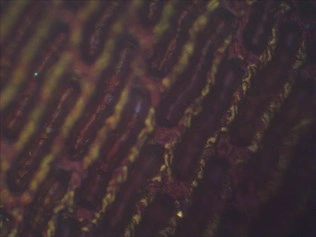
laser cleaning with LaserEcoClean.
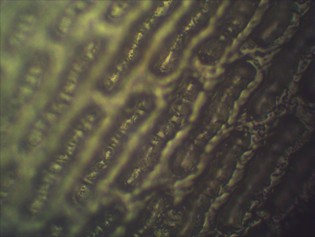
laser cleaning with LaserEcoClean.
The roll then looks and transfers ink like a new one, apart from its natural wear.

with LaserEcoClean.
Advantages and disadvantages of anilox roll laser cleaning
Every laser technology has its disadvantages.
UV inks and coatings can usually be removed without difficulty, but white alcohol-based and water-based inks that have hardened on the cell floors can sometimes be troublesome.
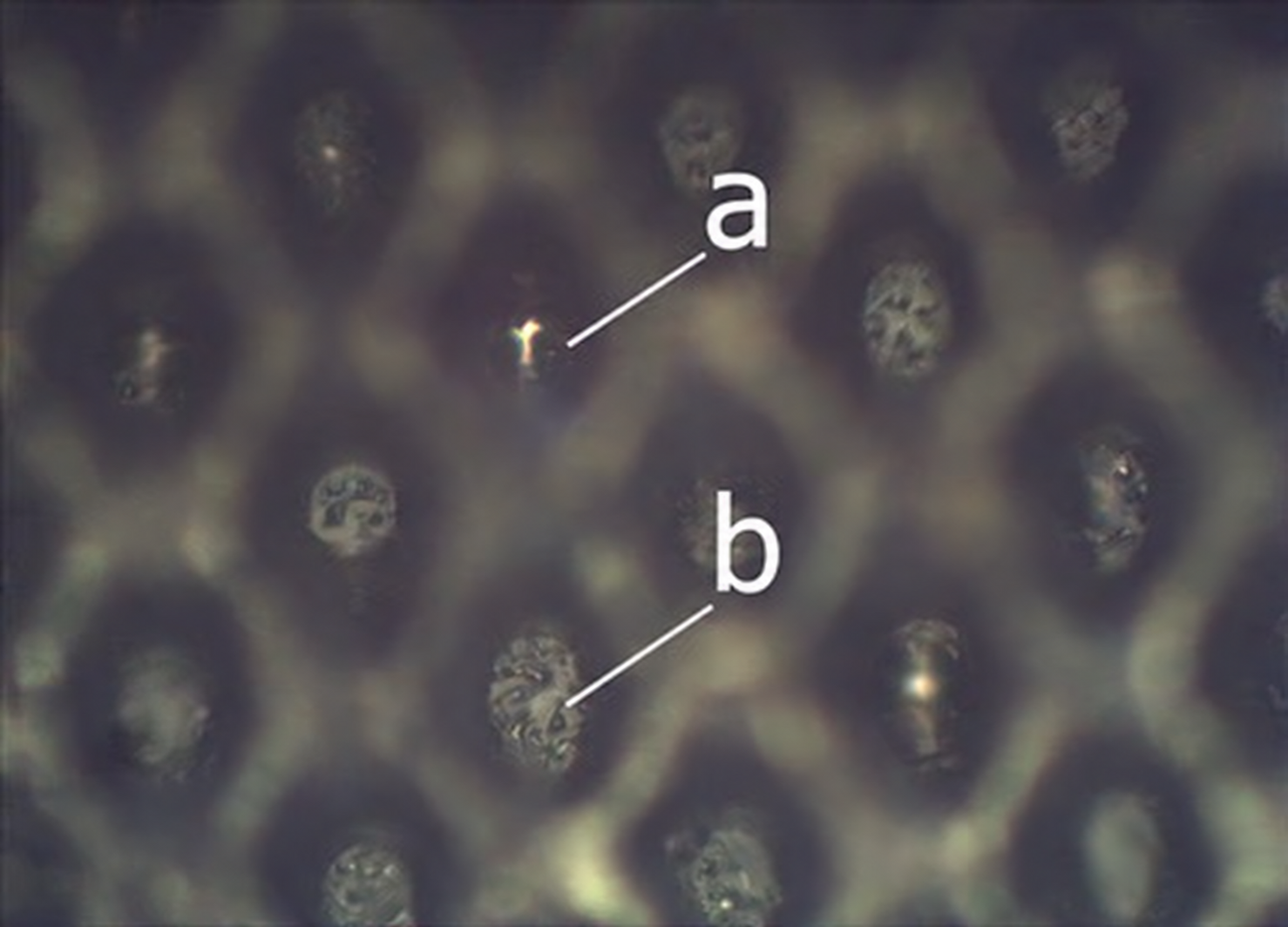
Ink that has hardened in this way is very difficult to remove chemically and is removed only with difficulty by ultrasonic cleaning; rolls whose cells remain 15–20% blocked may continue in service for several years. The ink in those cells hardens to such an extent that removing it can require two to five passes of the laser beam.
We scan the roll with the laser beam in a helical path, and initially had difficulty cleaning rolls with uneven contamination.
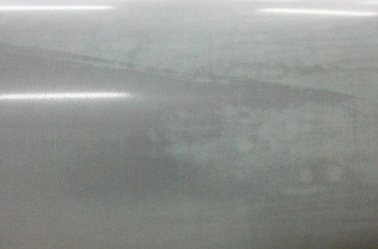
We solved the problem by developing special laser cleaning parameters and using extremely short laser pulses at a high repetition frequency.
Another problem for us, as a company providing roll-cleaning services, is the limited effectiveness of the cleaning methods already installed in printing companies. Regardless of the cleaning systems used at the plants we visit, the cells from which we remove ink are, in the overwhelming majority of cases, 20–30% blocked. Rolls with this level of contamination take longer to clean than rolls that have been carefully maintained — a rarity. For example, cleaning a 1,330 mm roll from Press No. 1 at one of Germany’s largest printing companies takes 60 minutes with our process, whereas cleaning the roll from Press No. 2 (which is 1,346 mm long) takes 38 minutes. The difference lies in the daily roll-washing system installed in each press. The system in Press No. 2 is better, so non-removable residues of dried ink accumulate more slowly on the cell floors. This indicates that the principal cause of rapid accumulation of non-removable residue on the cell floors is the absence or poor quality of daily roll-care procedures.
Our purpose is not to disparage any conventional or modern anilox cleaning method. Every technology has its own niche. Chemical cleaning is always at hand; ultrasonic cleaning is inexpensive and familiar. Nevertheless, the quality achieved by conventional cleaning methods differs markedly from that delivered by laser ink removal.
Comparison of laser cleaning with ultrasonic and chemical anilox cleaning.
We conducted studies at large printing companies in which we compared chemical cleaning and ultrasonic cleaning with roll cleaning using LaserEcoClean. We asked the plant to clean a roll — 340 lpcm, 4.9 cm³/m² , cyan — chemically or ultrasonically, after which we cleaned half of the same roll with our technology. The printers produced a solid patch, and the process engineers assessed the difference in ink transfer by optical densitometry, gravimetry and cell-volume measurements using a Troika AniCAM. Measurements of the prints showed that, after chemical cleaning, Dᵣ increased from 1.30 before cleaning to 1.42 afterwards. LaserEcoClean cleaning of the same roll increased Dᵣ to 1.63.
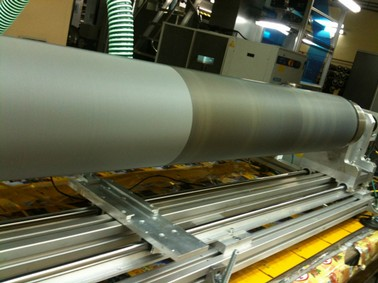
with half of it subsequently cleaned by laser.
Cleaning the roll after ultrasonic cleaning produced the following results: ink laydown increased from 0.2 after ultrasonic cleaning to 0.4 after LEC cleaning, while optical density rose from 2.58 to 2.68. On another roll, cell volume increased from 6.3 cm³/m² after ultrasonic cleaning to 7.0 cm³/m² after LEC cleaning, while optical density rose from 0.17 to 0.33.
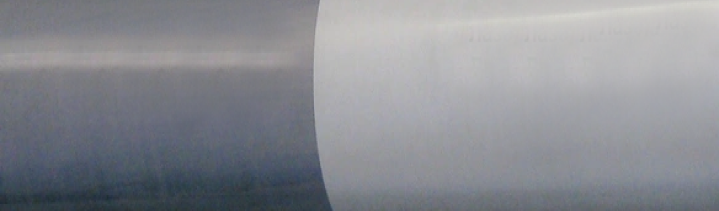
You have undoubtedly achieved the required ink transfer from a moderately contaminated roll by cleaning it chemically. What you may not have known is that ink which has not been completely washed away can remain on the cell floors, and that non-removable residue may accumulate there much faster than it does on a new roll or on one that has been laser-cleaned.
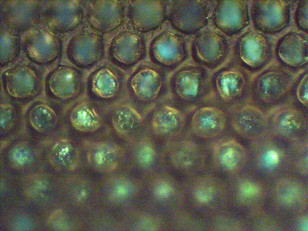
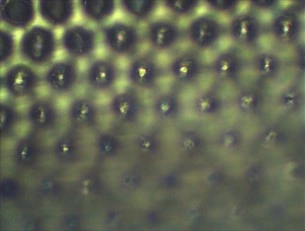
It is difficult to say how quickly a roll will lose its specified ink-transfer value after one cleaning method or another. Only one thing can be stated unequivocally: after laser cleaning, the roll will retain its ink-transfer characteristics for as long as a new roll would at your plant, taking account of the ink types, number of print runs and quality of the daily, weekly and monthly roll-washing procedures.
LaserEcoClean anilox roll laser cleaning
In 2013, we can speak of a new era in roll cleaning. Today, thanks to laser cleaning, you can restore a roll’s ink transfer to its specified value in 30 minutes. With our LaserEcoClean technology, this can be done without damaging the ceramic. No further action is required after cleaning: the anilox roll can be installed in the press immediately.
By using clean anilox rolls in your printing company every day, you can make flexographic production more controlled and more predictable.
At the same time, our cleaning technology requires no consumables. Manual, automated and ultrasonic cleaning, by contrast, all involve monthly expenditure on consumables.
We manufacture anilox roll laser-cleaning equipment incorporating LaserEcoClean technology.
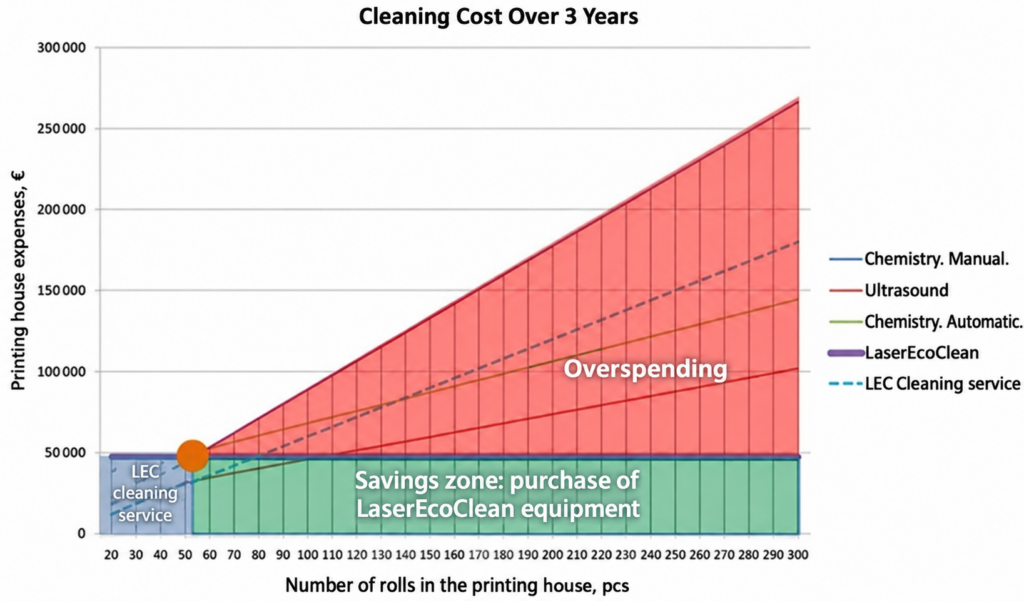
in the third year of operation, based on the following assumptions:
one container of cleaning chemical — €200–300,
consumption — one container per ten rolls per month.
Ultrasonic cleaning fluid: €8/litre;
consumption — 0.3 litres per roll.
Chemical cleaning fluid: €18/litre;
consumption — 0.5 litres per roll.